

Ugh — you know the feeling.
You’ve just finished your morning routine feeling glowy and responsible. Moisturizer? Done. Sunscreen? Absolutely (because you’re a skincare rockstar). Now it’s makeup time… and the second you start blending foundation, it happens.
Those annoying little rolls and gritty bits — like your face is shedding tiny “eraser shavings” of product.
That, friend, is sunscreen pilling. And it’s the absolute worst.
It’s the kind of problem that makes you want to rinse everything off and start over… or, even worse, skip SPF altogether. (Please don’t — we’re going to fix this.)
Because here’s the truth: pilling doesn’t mean your sunscreen is “bad,” and it definitely doesn’t mean you’re doing skincare wrong. It usually comes down to layering, texture clashes, and timing — and once you understand what’s triggering it, you can stop it fast.
So why does sunscreen betray us like this? Let’s get into it — no jargon, no fluff. Just real-world fixes that actually work.
We’re going to troubleshoot this like a pro: what causes pilling, how to layer your routine correctly, and the quickest “save my makeup” fixes—so your base stays smooth, not gritty. And if you want shortcuts, I’ll also share what to look for in a sunscreen that plays nicely with foundation, plus the easiest ways to reapply SPF without smudging or rolling.
See my best sunscreens under makeup (2026) for no-pill formulas that actually behave with foundation.
And if midday touch-ups are where everything falls apart, don’t miss how to reapply sunscreen over makeup—no smudging, no patchiness, no pilling.
Why Sunscreen Pilling Happens (And Why It Gets Worse Under Makeup)
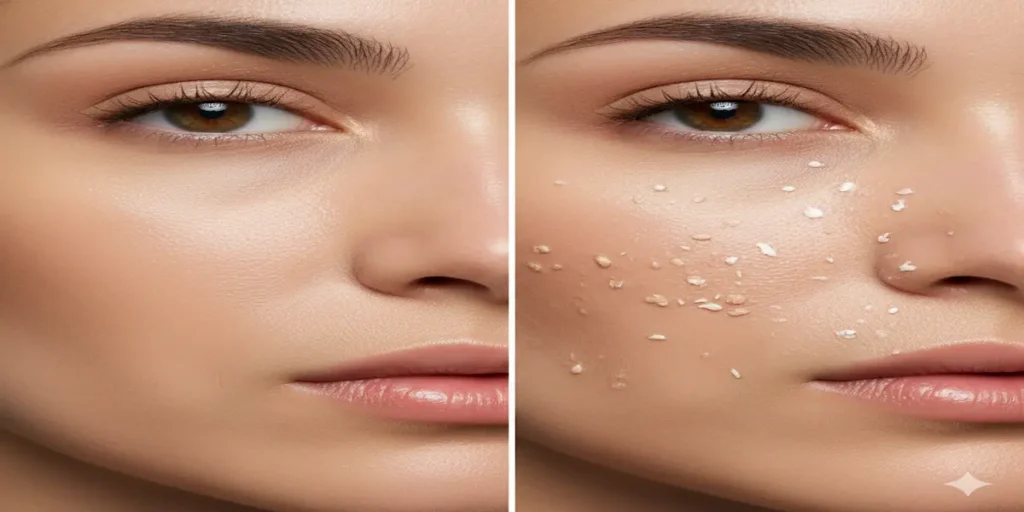
If sunscreen has ever started rolling up into little grey-ish crumbs the moment you touch your face… yeah. That’s pilling.
It’s basically your skincare + SPF forming a thin film on top of the skin (which is what it’s supposed to do), and then that film gets disturbed — usually by friction, layering, or too much product. The result looks like tiny eraser shavings. Not cute. Not “glowy.” Just… annoying.
And makeup makes it worse for one simple reason: makeup adds movement.
Foundation brushes. Sponges bouncing. Fingers blending concealer. Powder sweeping. Each step adds a bit of rubbing or dragging, and that “set” sunscreen film can start to lift, ball up, and separate.
A few super common triggers:
- Too much product, too fast. Sunscreen is generous by design, but if you’re also layering moisturizer + serum + primer, you can hit overload.
- Not enough dry-down time. Sunscreen needs a minute to settle. When it’s still tacky and you layer over it, it’s more likely to shift.
- Texture mismatch. Think: watery gel SPF + thick silicone primer, or rich cream SPF + heavy foundation. They can fight.
- Rubbing instead of pressing. This one is sneaky. Even “light blending” can be enough to cause rolling.
If you’re reading this because your base looks perfect… and then suddenly flakes off around your nose or chin the moment you blend? You’re not doing anything “wrong.” You’re just dealing with product chemistry and friction.
Let’s fix it.
The #1 Cause: Product Layering Conflicts (Silicones, Polymers, and Texture Mismatches)
Okay, here’s the simplest way to think about it:
Some products are “slippy.” Some are “grippy.”
When you stack too many slippy-on-slippy layers (or grippy-on-grippy), they can start to grab, bunch, and roll instead of melting together.
What usually causes the conflict?
1) Silicone-heavy layers stacked together
Silicones can be amazing for smoothing pores and making makeup glide. But if your sunscreen feels silky and your primer is very silicone-y, the layers can slide on top of each other like two satin sheets. Then you blend… and the top layer starts to ball up.
2) Film-formers + rubbing
Many sunscreens contain film-forming ingredients that help them stay even and protective. Great for SPF performance. But those films don’t love being “worked” repeatedly with brushes and sponges before they’ve set.
3) Texture mismatch
- Gel sunscreen + thick primer
- Rich cream sunscreen + matte foundation
- Heavy moisturizer + sunscreen + primer (all thick)
Sometimes it’s not one product that’s “bad.” It’s the pairing.
Quick “which product is the problem?” test (takes 2 minutes)
Try this on a clean hand or jawline:
- Apply your moisturizer (your normal amount).
- Apply sunscreen (your normal amount).
- Wait 2 minutes.
- Apply your primer on one side only.
- Blend foundation over both sides.
If pilling happens only where primer is, the primer/SPF pairing is the issue.
If it happens everywhere, it’s usually sunscreen amount, dry-down time, or your application technique.
And yes… sometimes the fix is boring.
It’s as simple as using less of one step, waiting slightly longer, and pressing instead of rubbing.
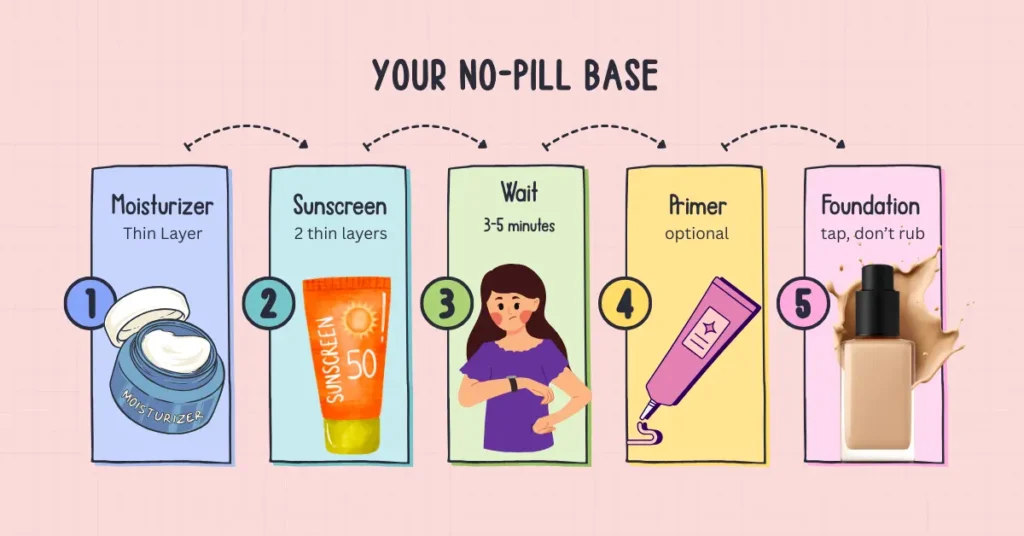
The Right Order: Moisturizer → Sunscreen → Primer → Foundation (So Nothing Rolls Up)
Let’s make your base behave like it has manners.
Here’s the order that keeps things smooth (and gives your SPF the best chance to sit evenly):
Step 1: Moisturizer (thin, even, not greasy)
You don’t need a thick blanket here. You need a comfortable slip so sunscreen doesn’t cling to dry patches.
If you’re using serum + moisturizer, keep it light. Think: “hydrated,” not “slathered.”
Step 2: Sunscreen (the full amount — but applied smartly)
This is where most people accidentally trigger pilling.
Instead of rubbing like lotion, do this:
- Dot sunscreen across the face
- Press and spread in thin passes
- Do a second thin pass if you need it (especially cheeks/forehead), instead of one thick layer
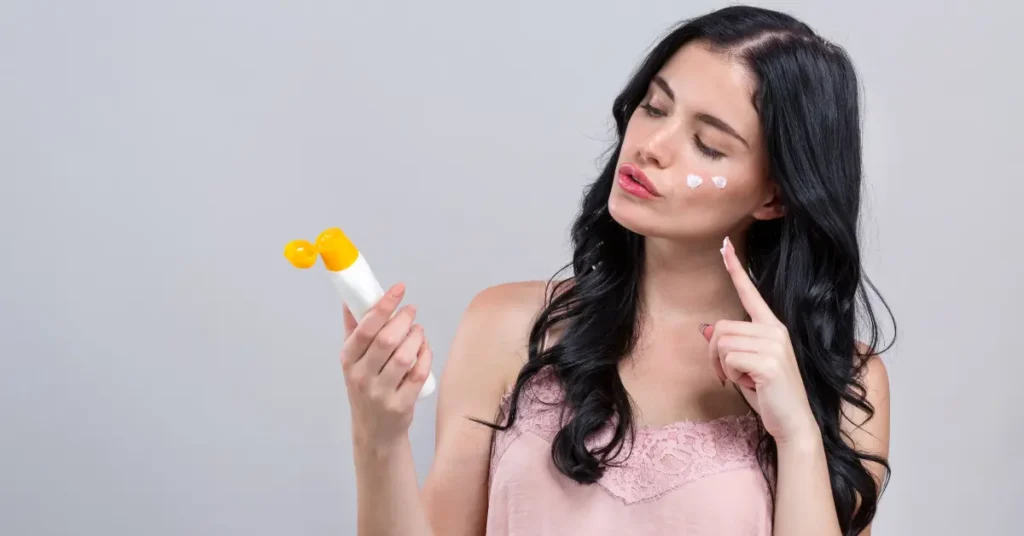
It should look dewy for a moment… then start to settle.
If you’re still hunting for formulas that don’t roll under foundation, start with my Best Sunscreens Under Makeup (2026) roundup — it’s packed with no-pill picks that actually behave.
Step 3: Wait (yes, it matters)
Even 2–5 minutes changes everything. Not because you’re “waiting for SPF to work” like magic… but because you’re letting the film set so it doesn’t roll when touched.
(We’ll get into realistic wait times in the next section.)
Step 4: Primer (optional, but choose wisely)
Primer isn’t mandatory if your sunscreen already gives a smooth finish.
But if you do use primer:
- Use a small amount
- Press it in (don’t massage)
- Focus only where you need it (T-zone, pores, smile lines)
If you’re using primer (especially on mature skin), choose formulas that smooth without grabbing. My favorites are here: Best Organic Face Primers for Mature Skin.
“Mature and menopausal skin also tends to have a weaker moisture barrier, which makes the right daytime moisturiser crucial — see our picks for the best lotion for menopausal dry skin to find one that layers cleanly under SPF without adding to the pilling problem.”
If you want to understand why menopausal skin behaves so differently with layered products, our full guide to skin changes during menopause explains the barrier changes that make timing and product texture so much more critical after 45.
“If you’re ready to start shopping, we’ve rounded up the best lotions for menopausal dry skin — all barrier-repairing, all fragrance-free, with options for the face, body, and crepey skin specifically.”
“Outside: A simple, fragrance-free routine centred on barrier repair — our guide to the best lotion for menopausal dry skin covers exactly which ingredients to look for and which to avoid, with product picks for both face and body.”
Step 5: Foundation + Concealer (gentle technique wins)
Use a damp sponge or a soft brush and tap instead of buffing in circles. Buffing is where pilling loves to show up.
If you’re unsure which step should go first, this quick guide clears it up: Concealer or Foundation First?
Getting your SPF to sit perfectly is just one piece of a strong morning routine. If you’re working on your overall radiance alongside getting your base to behave, our guide on how to get natural glow on face covers the full morning and evening routine — including exactly where sunscreen fits in the glow picture.
How Long to Wait After Sunscreen Before Makeup (Realistic Timing That Works)
I know. Waiting is the least glamorous part of getting ready.
But this is one of those tiny habits that makes your base look… expensive. Like it was airbrushed on. And it’s also the simplest way to stop pilling without buying anything new.
The short answer
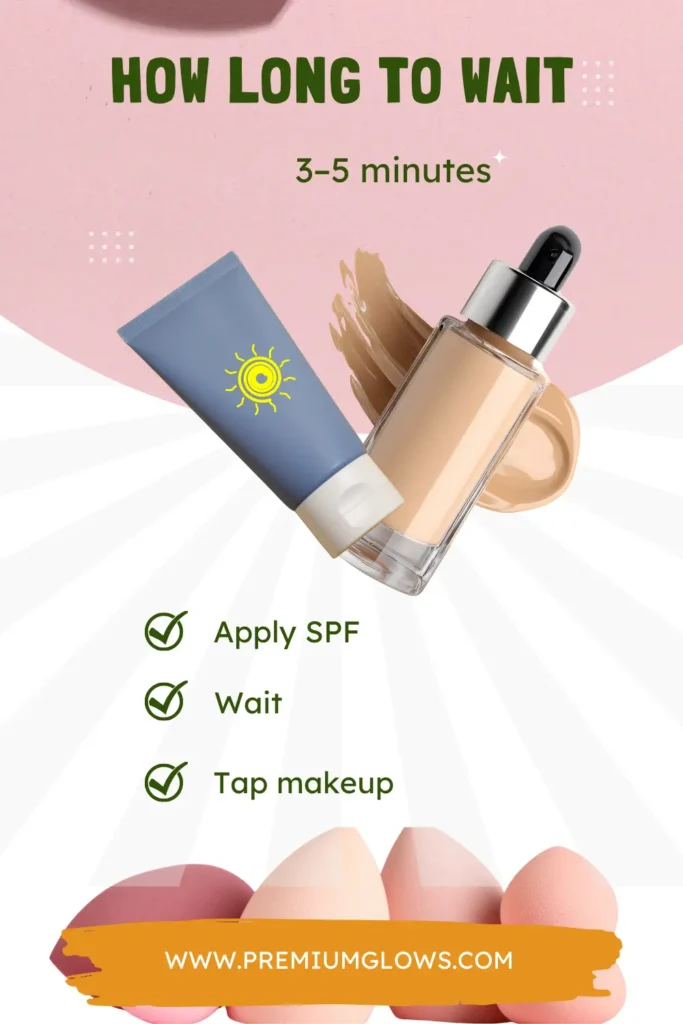
Wait 3–5 minutes after sunscreen before primer/foundation.
If you’re using a richer cream sunscreen (or you layered moisturizer + sunscreen), lean closer to 5–8 minutes.
What you’re actually waiting for
You’re not “activating” the SPF. You’re letting it set into an even film on the skin.
When you apply makeup while sunscreen is still tacky:
- your sponge/brush drags the product
- the sunscreen film lifts
- and it starts rolling into little pills (especially around the nose, chin, and mouth)
A super practical “ready test”
Touch one cheek lightly with a clean fingertip.
- If it feels wet or slippery → wait 2 more minutes
- If it feels slightly tacky but not moving → you can apply primer by pressing
- If it feels set (like a soft grip) → foundation will sit best
If you don’t have time (the “I’m late” version)
Do this instead of skipping the wait entirely:
- Apply sunscreen in two thin layers (faster to set than one thick layer)
- Use a fan / hairdryer on cool for 15–20 seconds
- Start makeup with tapping, not buffing
Not perfect. But it saves your base.
Different skin types, different timing
Your moisturizer + SPF combo can stay “dewy” longer. Give it 5–8 minutes, especially if you’re using a hydrating foundation. If you want base makeup that won’t cling or crack, you’ll love: 9 Best Foundation for Ladies Over 50.
Oily / combo skin:
Often sets faster, but can pill if you over-layer. Keep moisturizer light and wait 3–5 minutes.
Bonus: where pilling usually starts (so you can prevent it)
Most people pill in the same zones:
- sides of the nose
- upper lip
- chin
- smile lines
So here’s a simple trick: once sunscreen is on, don’t keep touching those areas. No smoothing. No “fixing.” Let it set.
How to Apply Sunscreen So It Doesn’t Pill (Thin Layers, Pressing, Not Rubbing)
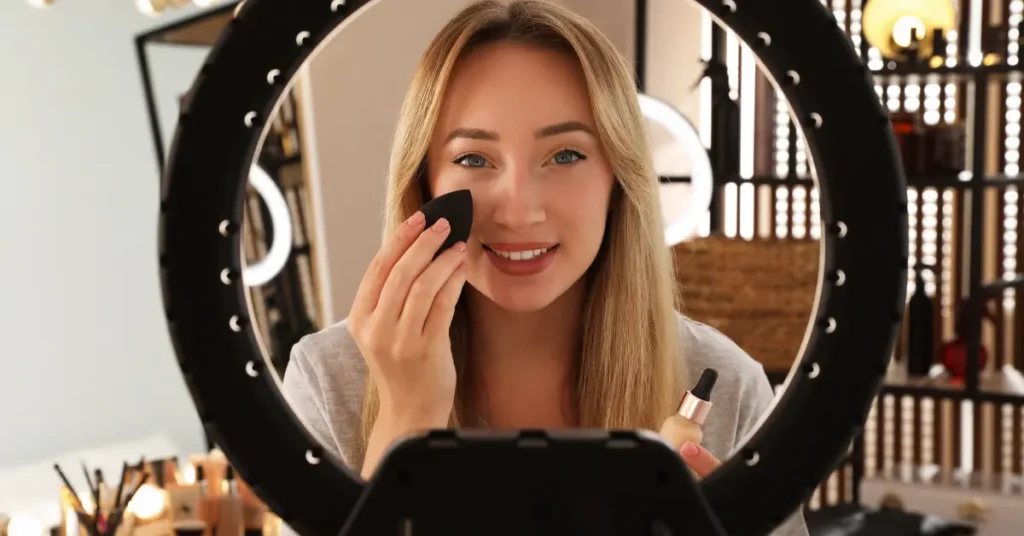
This is the part nobody tells you, and it changes everything:
Pilling is usually application technique, not sunscreen quality.
Even a gorgeous “under-makeup” SPF can pill if it’s rubbed in like body lotion.
The “No-Pill” sunscreen application method
Step 1: Dot, don’t swipe
Dot sunscreen across the face: forehead, cheeks, nose, chin.
Step 2: Spread gently in thin passes
Use fingertips and spread outward with light strokes—just enough to distribute.
Step 3: Press it in
Now switch to pressing/tapping motions. Especially around the nose and mouth.
Step 4: Two thin layers beat one thick layer
If you’re worried about using enough sunscreen (and you should be), do:
- Layer 1: thin, even
- 60–90 seconds
- Layer 2: thin, targeted (cheeks/forehead)
This helps it dry down smoothly without that heavy, roll-prone film.
The biggest mistakes that cause pilling (quick checklist)
- ❌ applying sunscreen over skincare that hasn’t absorbed
- ❌ using too much moisturizer + too much sunscreen
- ❌ rubbing sunscreen back and forth until it “feels dry”
- ❌ buffing foundation in circles right on top of tacky SPF
- ❌ adding primer everywhere when you only need it in the T-zone
The makeup technique that prevents pilling instantly
Start foundation with tapping, not buffing.
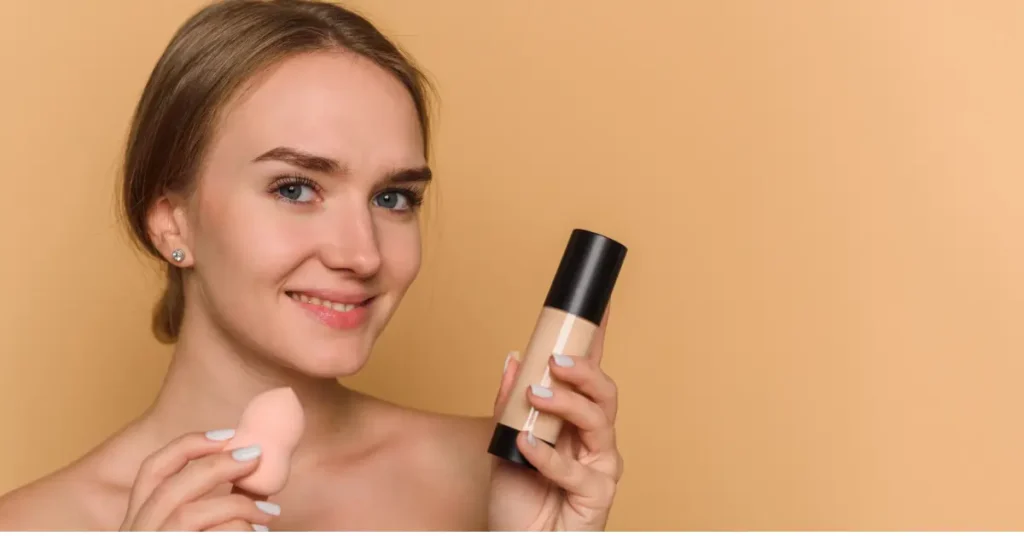
Think of it like placing fabric on a bed:
- tapping = laying it smoothly
- buffing = scrunching it up
A damp sponge is your best friend here.
Fix It Fast: What to Do When Sunscreen Starts Pilling Up on Your Face

Okay—real life.
Sometimes you’ve already done your skincare. You’ve already started foundation. And then… the little rolls appear.
Don’t panic. Don’t keep rubbing. That makes it snowball.
Step-by-step “save your makeup” rescue
1) Stop blending that area immediately
The more friction, the more pilling.
2) Gently brush away the pills
Use a clean fluffy brush or a tissue. Lightly flick them off—don’t smear them.
3) Add the tiniest bit of moisture
Pick one (tiny amount):
- a drop of moisturizer
- a hydrating mist sprayed onto a sponge (not directly on the face)
- a dab of setting spray on a sponge
Then press the area gently to smooth it.
4) Re-press foundation
Use a sponge and tap a whisper-thin layer back over the spot.
5) Set strategically
A light dusting of powder (only where needed) helps stop further movement.
Read: Best Face Powder for Mature Skin
If pilling keeps happening in the same place every time…
That’s usually one of these:
- your primer and SPF are fighting
- you’re applying too much product in that zone
- you’re touching the area repeatedly while it’s drying
The fix isn’t “more blending.”
It’s less product + more pressing + more patience.
Mineral vs Chemical Sunscreen: Which Pills More (And How to Make Either One Behave)
If you’ve ever heard, “Mineral always pills” or “Chemical is always smoother”… it’s kind of true, but not the whole story.
Here’s the real deal:
Which one pills more?
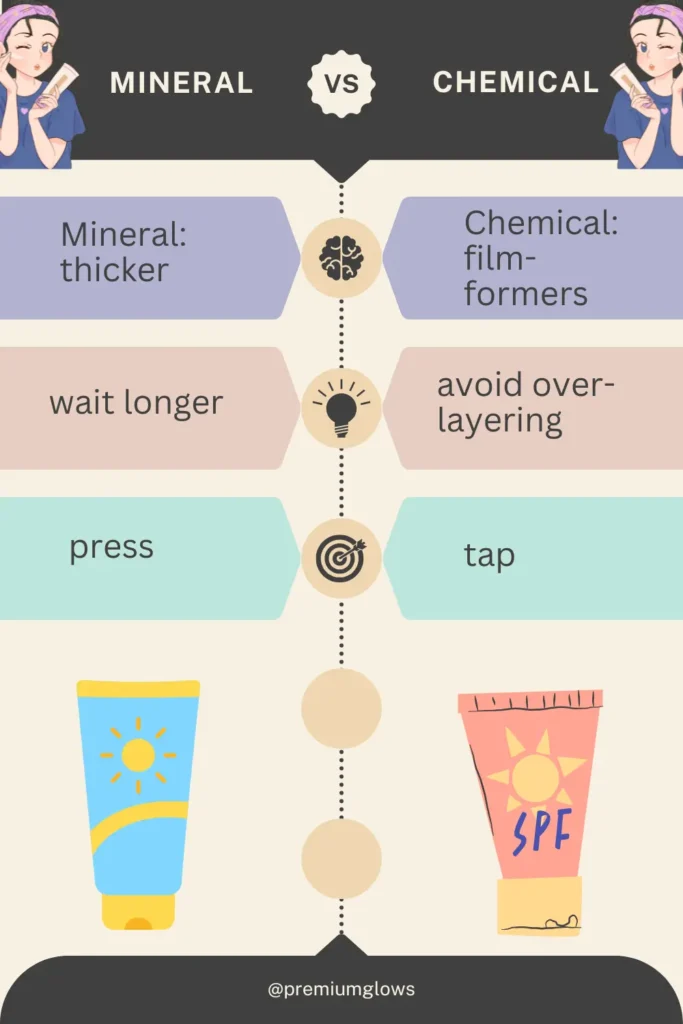
Mineral sunscreens are more likely to pill because they often sit more “on top” of the skin (zinc oxide/titanium dioxide are physical filters), and many formulas use thicker bases to keep those filters evenly suspended.
But chemical sunscreens can pill too — especially the very silky, film-forming ones that feel like a primer.
So it’s not mineral vs chemical alone. It’s finish + thickness + how you apply it.
How to stop mineral sunscreen from pilling
Mineral SPF can look absolutely beautiful under makeup… when you treat it gently.
- Moisturize first (but keep it thin). Dry patches grab mineral formulas and make rolling worse.
- Apply in two thin layers. One thick layer is the fastest route to “eraser crumbs.”
- Press, don’t rub. Mineral filters don’t like friction.
- Wait longer. Give mineral SPF 5–8 minutes before foundation if you can.
- Avoid heavy silicone primers on top. Many mineral formulas already have slip; piling more slip can cause sliding + rolling.
If you’re still searching for the right mineral formula, our best mineral sunscreen for sensitive skin covers 11 zinc-based options that are gentler to layer and less likely to roll.
How to stop chemical sunscreen from pilling
Chemical sunscreens are often lighter, but they can be “film-y” — they create that smooth, flexible layer that makeup can sometimes tug on.
- Use less skincare underneath. If your moisturizer is rich, your SPF might never fully set.
- Let it dry down fully. Aim for that “set but comfortable” feel.
- Start makeup with tapping. No buffing for the first minute of base application.
- Skip primer if your SPF already feels like one. (You’d be shocked how often this alone fixes pilling.)
The easiest way to know what your sunscreen needs
Look at the finish when it dries:
- If it dries very dewy/tacky: wait longer + use less primer
- If it dries very silky/slippy: use minimal primer and press foundation in
- If it dries thick or “powdery”: hydrate underneath and use tapping motions.
“Some sunscreens are basically made for makeup—here are my no-pill picks.”
→ Best Sunscreens Under Makeup (2026)
What Primer Works Best With Sunscreen (And Which Ones Trigger Pilling)
Let’s talk primers, because this is where most “SPF pilling under makeup” drama starts.
Primers aren’t the enemy… but the wrong primer + your sunscreen can be a messy breakup.
The best primers to pair with sunscreen
You want primers that layer quietly. No tugging. No slipping. No grabbing.
Look for primers that are:
- lightweight
- hydrating or smoothing (not overly silicone-thick)
- easy to press in with fingertips
- meant to work over skincare (not just bare skin)
Best primer texture matches (simple guide):
- Dewy/hydrating sunscreen → use a light, balancing primer (or skip primer)
- Silky sunscreen → use a tiny amount of primer only in the T-zone
- Thick mineral sunscreen → use a hydrating primer sparingly, pressed in
Primers that commonly trigger pilling (what to avoid)
These aren’t “bad” products — they’re just more likely to fight with SPF:
- Very thick silicone primers (feel like velvet, blur instantly)
Why they pill: they can sit on top of SPF and slide/roll when blended. - Grippy/tacky primers (the ones that feel like glue)
Why they pill: they can grab the sunscreen film and pull it up. - Primers with lots of powdery “mattifying” ingredients
Why they pill: they can clump when layered over a still-drying sunscreen.
The “primer amount” rule most people ignore
If you use primer, use less than you think.
Like… a pea-size for the whole face is often too much.
Try this instead:
- a half-pea total
- press onto only the areas you need (pores, T-zone, smile lines)
- leave cheeks alone if they’re already smooth
A quick compatibility test (before you commit to a full face)
Do it right on your cheek:
- Sunscreen
- Wait 3–5 minutes
- Primer (tiny amount)
- Tap foundation on top
If it pills, it’s a pairing issue. Switch primer style, not necessarily sunscreen.
If it still pills, it’s usually a primer–SPF mismatch. Try a lighter, skincare-friendly primer (or use primer only where you truly need it). If you want options that behave beautifully on mature skin, here are my favorites: Best Organic Face Primers for Mature, Aging Skin.
And if your base still looks patchy, the order can make a surprising difference—here’s the simple rule I follow: Concealer or Foundation First?
Sunscreen That Doesn’t Pill Under Makeup: What to Look For Before You Buy
Let’s make this easy—because the goal isn’t to “force” a sunscreen to work with makeup. It’s to choose one that already behaves.
The best under-makeup sunscreens have one vibe in common:
They dry down into a smooth, even film… without staying tacky or overly greasy.
Not too sticky. Not too slippery. Just… quietly polished.
What to look for (the under-makeup checklist)
When you’re scanning a product page or reading labels, these clues usually signal “no-pill potential”:
1) Descriptions like:
- “invisible finish”
- “fast-absorbing”
- “weightless”
- “smooth base”
- “works well under makeup”
- “no white cast” (often means the texture is refined)
2) A finish that matches your makeup goals
- If you love cloud skin (soft, blurred, velvety): look for natural/satin finish SPFs
- If you wear matte foundation: pick an SPF that dries more natural (not super dewy)
- If you wear dewy base: your SPF can be hydrating, but it must set, not stay wet
If you’re chasing that soft-focus, velvety “cloud skin” finish, your SPF texture matters even more—this guide breaks down the look (and the best base techniques): Cloud Skin Makeup: The Science-Backed Guide.
3) Texture matters more than “mineral vs chemical”
A thin lotion, gel-cream, or fluid tends to layer better than very thick creams.
If you’re frequently dealing with pilling, avoid sunscreens that:
- feel very heavy
- remain tacky for 10+ minutes
- leave a thick “coating” feeling
The biggest “no-pill” green flag
Here’s the simplest test once you own it:
Apply sunscreen → wait 5 minutes → run one finger lightly across your cheek.
- If it smears and rolls immediately, it’s going to fight with makeup.
- If it feels set and smooth (even slightly grippy), it’s usually makeup-friendly.
Build your routine around one hero product
This is the part many people overlook…
If your sunscreen already looks like a primer (smooth, slightly blurring), you probably don’t need primer everywhere. Pilling often disappears the second you stop stacking “base” products.
Want a shortcut? I rounded up formulas that consistently sit smoothly under foundation (no rolling, no patchiness): Best Sunscreens Under Makeup (2026): 12 No-Pill Picks.
Reapplying SPF Over Makeup Without Pilling (Powder, Mist, Cushion, Stick Options)
The best tool for this is a sunscreen stick — our guide to the best sunscreen sticks for face has 10 SPF 50+ picks that glide over makeup without rolling or smearing.
Reapplying sunscreen is the responsible thing… and also the moment your makeup can go from “fresh” to “patchy” in 30 seconds.
So we’re not going to rub. We’re not going to smear. We’re going to layer SPF like a pro.
The golden rule: press, don’t rub
Reapplication is not skincare time. It’s makeup time.
Anything that drags across the skin can lift:
- foundation
- concealer
- powder
- and yes, that sunscreen film underneath
So the technique is always: tap, press, pat.
Choose your reapplication format (based on your skin + makeup)
1) SPF Cushion (best for dry skin + natural finish)
- feels like touching up makeup
- great for cheeks and high points
- easiest to control coverage
How to use:
Tap in light layers, starting where you get most sun exposure.
2) SPF Stick (best for targeted, mess-free touch-ups)
- ideal for on-the-go
- best for “zones” (forehead, nose, cheeks)
Pro tip:
Swipe gently, then press with a sponge so it melts into your makeup instead of sitting on top.
3) SPF Powder (best for oily skin + midday shine control)
- great over a solid morning sunscreen base
- perfect for the T-zone
- the least disruptive to makeup
How to use:
Press and roll (don’t dust like fairy glitter). Be generous enough to matter.
→ Best Face Powder for Mature Skin
4) SPF Mist/Spray (best as a topper, not your only method)
Sprays can be helpful—but people under-apply them. One light cloud isn’t enough.
How to use it so it doesn’t pill:
- hold at the right distance
- mist evenly
- let it dry fully
- don’t touch your face while it sets
If your makeup always pills during reapplication…
Two things usually fix it fast:
- Blot first (remove oil so products don’t slide)
- Use a sponge to press whatever SPF format you choose
For step-by-step touch-ups (powder, stick, mist, cushion) that won’t wreck your base, follow this guide: How to Reapply Sunscreen Over Makeup (2026).
Quick Troubleshooting Table: “Problem → Cause → No-Pill Fix” (Save This Section)
Sometimes you don’t need a new sunscreen. You need a diagnosis.
Here’s the “what’s happening on my face?” cheat sheet—so you can fix pilling in minutes, not months.
Sunscreen Pilling Troubleshooting Table
Problem: Pilling starts the moment you blend foundation
Likely cause: Sunscreen hasn’t set + you’re buffing with friction
No-pill fix: Wait 3–5 minutes. Start base with tapping (sponge/fingers), not circular buffing.
Problem: Pilling only happens around the nose/mouth
Likely cause: Too many layers in high-movement areas + touching while drying
No-pill fix: Use less product there. Press sunscreen in. Avoid rubbing primer on those zones.
Problem: Pilling happens only where primer is applied
Likely cause: Primer + sunscreen texture conflict (silicone vs tacky/grippy)
No-pill fix: Switch primer type OR use primer only in the T-zone (tiny amount). Press, don’t massage.
Problem: Makeup looks patchy and “skips” over sunscreen
Likely cause: Sunscreen film is thick or uneven (one heavy layer)
No-pill fix: Apply SPF in two thin layers. Let each settle. Don’t overwork the foundation.
Problem: Sunscreen pills when you reapply SPF over makeup
Likely cause: Oil + rubbing + layering too much product at once
No-pill fix: Blot first. Use a cushion/powder/stick and press with a sponge.
Problem: Pilling happens with mineral sunscreen specifically
Likely cause: Formula is thicker and doesn’t like friction
No-pill fix: Hydrate lightly underneath, apply in thin layers, wait longer (5–8 minutes), tap makeup on.
Problem: Sunscreen looks fine… until you add powder
Likely cause: Powder is too dry/heavy or being swept aggressively
No-pill fix: Use a light hand. Press powder only where needed. Choose a finer-milled setting powder.
Best Face Powder for Mature Skin (because powder choice matters a lot for texture and rolling)
FAQs: Why Does My Sunscreen Pill, and How Do I Stop It?
Why is my sunscreen pilling?
Usually because your layers are too thick, your sunscreen hasn’t fully set, or your primer/foundation is tugging at the sunscreen film. It’s most common when you rub instead of press, or when products with different finishes don’t layer smoothly.
Why does my sunscreen pill under makeup specifically?
Makeup adds friction—sponges, brushes, fingers blending. If sunscreen is still tacky (or applied too thickly), that friction lifts it and it rolls into tiny pills.
How long should I wait after sunscreen before applying makeup?
3–5 minutes is the sweet spot for most sunscreens. If your sunscreen is rich, very dewy, or mineral-based, 5–8 minutes often works better.
Should I put primer before or after sunscreen?
After sunscreen. Sunscreen needs to sit closest to the skin to form an even layer, and primer goes on top to smooth and grip makeup.
Read: Best Organic Face Primers for Mature, Aging Skin
What’s the best way to apply sunscreen so it won’t pill?
Apply sunscreen in thin layers, spread gently, then press it in—especially around the nose and mouth. Two thin layers are usually better than one thick layer.
What if my sunscreen pills even without makeup?
That usually points to skincare underneath that hasn’t absorbed (heavy moisturizer/oily layers), or you’re rubbing sunscreen too aggressively. Try using less moisturizer, waiting a bit longer, and pressing sunscreen in.
How do I stop sunscreen from pilling when reapplying over makeup?
Blot oil first, then reapply using a powder, cushion, stick, or mist—and press it in. Avoid rubbing. Rubbing is what makes it roll.
Read How to Reapply Sunscreen Over Makeup (2026)
Conclusion: Your No-Pill SPF Routine (Simple, Repeatable, Works)
If sunscreen is pilling, it’s not a “you” problem. It’s usually a layering problem.
Keep it simple:
- Light moisturizer
- Sunscreen in thin layers
- Wait 3–5 minutes
- Press primer (optional)
- Tap makeup on gently
And if you want the easiest shortcut of all? Use a sunscreen that’s already made to sit beautifully under foundation.
📌 Related Articles:
- “Want the best no-pill formulas?” → Best Sunscreens Under Makeup (2026)
- “Need a touch-up method that won’t ruin your base?” Read How to Reapply Sunscreen Over Makeup (2026)
Leave a Reply