


Wavy hair is… a little moody.
Not in a dramatic way. More like:
“I looked incredible yesterday. Why am I fluffy today?”
If that’s you, you’re not doing anything wrong. Wavy hair just sits in that “in-between” zone—not straight, not curly—and it reacts to everything: shampoo choice, conditioner weight, weather, how wet your hair was when you styled, and yes… whether you couldn’t stop touching it while it dried. (We’ve all been there.)
So let’s make this routine simple. Repeatable. Real-life friendly.
This guide gives you:
- a step-by-step wavy hair routine (wash day + refresh day)
- the best product order for 2A–2C
- what to do when your waves feel limp, crunchy, frizzy, or stringy
- and exactly where your existing posts fit in (so you can interlink like a pro)
Disclosure: This post may contain affiliate links. If you buy through my links, I may earn a small commission—at no extra cost to you.
IN THIS ARTICLE
- The 30-Second Wavy Hair Routine Cheat Sheet
- Why Your Waves Look Different Every Day
- What Type of Wavy Hair Do You Have? (2A vs 2B vs 2C)
- Quick Hair Test: Porosity + Thickness
- How Often Should You Wash Wavy Hair?
- Step-by-Step Wavy Hair Routine (Wash Day)
- Non-Wash Day Routine (Refresh Day)
- Optional: Sleek Days (Straightening Without Frizz)
- If Your Waves Are… Do This
- The Small Mistakes That Quietly Ruin Waves
- Optional Finishing Touch: Hair Perfume
- FAQs
The 30-Second Wavy Hair Routine Cheat Sheet (Save This)
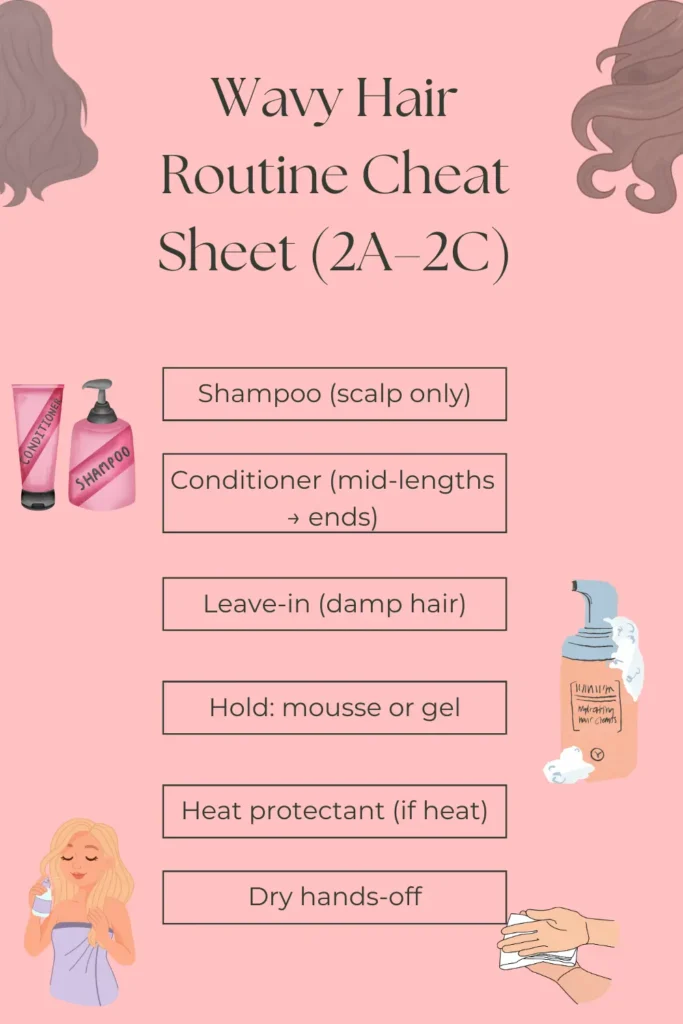
If you only want the basics, here’s your routine in one glance:
- Shampoo (scalp-focused, gentle)
- Conditioner (slip + frizz control)
- Leave-in (light definition + softness)
- Hold (mousse or gel—depending on your waves)
- Heat protectant (if diffusing or blow-drying)
- Dry hands-off (air-dry or diffuse)
- Optional smoothing serum (humidity/frizz days)
- Finish (optional hair perfume)
Beginner tip: Don’t try everything at once. Start with shampoo + conditioner + leave-in. Add hold last.
Want a simple starter kit for this routine? Don’t miss my roundup of the best hair products for wavy hair—lightweight picks that help waves look softer, more defined, and less frizzy.
Why Your Waves Look Different Every Day (It’s Not Just You)
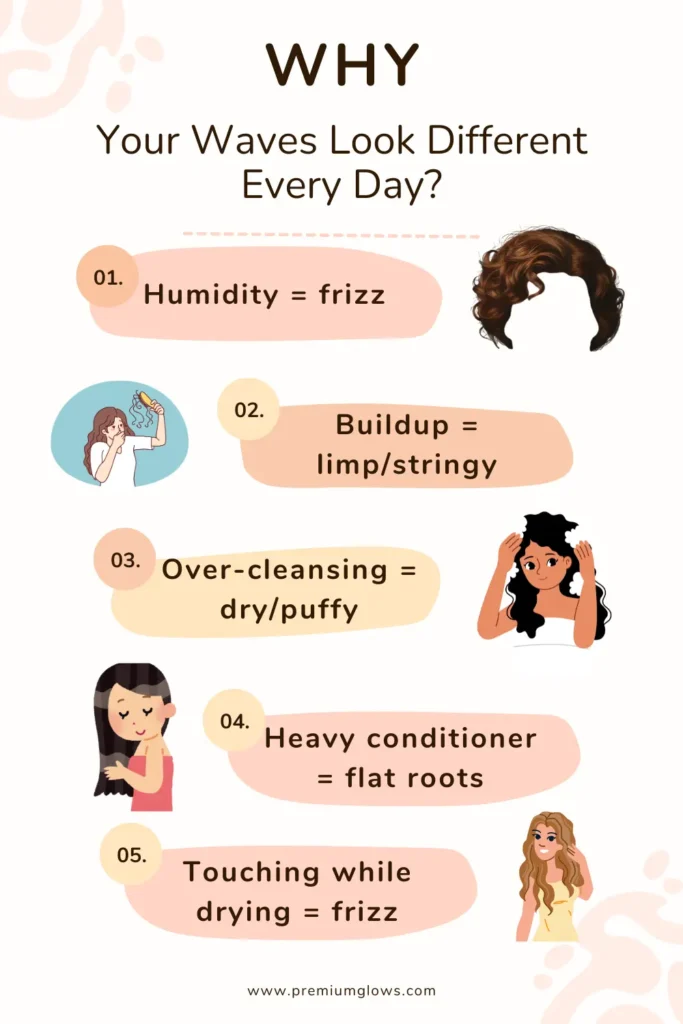
Let’s normalize this quickly. Wavy hair changes because:
- Humidity makes waves swell and frizz
- Buildup makes waves limp and stringy
- Over-cleansing makes hair puffy and dry
- Too-heavy conditioner flattens the root area
- Too much product creates that “wet noodle” look
- Touching hair while drying breaks wave clumps = frizz
If frizz is your main struggle regardless of which of these applies, the full breakdown in how to reduce hair frizz covers fixes for every cause — by hair type.
The fix isn’t adding 10 products.
It’s doing the right steps in the right order, and picking textures that match your wave type.
What Type of Wavy Hair Do You Have? (2A vs 2B vs 2C)
Quick guide:
- 2A: loose bends, can fall flat, hates heavy products
- 2B: defined “S” waves, frizz-prone, needs balanced moisture + hold
- 2C: thicker waves, more volume, closer to loose curls, usually needs more hydration + stronger hold
Your head can be a mix. That’s normal.
Not sure if your pattern is actually wavy or closer to curly? Our guide to wavy hair vs curly hair walks you through the exact differences and how to find your true hair type.
What matters most is how easily you get weighed down and how easily you frizz.
Wavy Hair Routine by Type (2A vs 2B vs 2C)
- 2A (fine + easily weighed down): lighter leave-in, mousse > gel, minimal oils
- 2B (classic S-waves): balanced leave-in + mousse or light gel
- 2C (thicker + frizz-prone): richer conditioner/leave-in + stronger hold, careful drying
Quick Hair Test: Porosity + Thickness (So You Stop Guessing)
1) Porosity (how your hair absorbs moisture)
- Low porosity: water sits on hair, products “coat,” hair takes longer to dry
✅ go lighter, apply on damp hair, avoid heavy layering - High porosity: hair absorbs fast, frizzes easily, dries quickly
✅ needs more conditioning + sealing, likes leave-in + a bit more hold
2) Thickness/Density (how much hair you have)
- Fine waves: need lightweight hydration + mousse-style hold
- Thick waves: can handle richer conditioner + stronger hold
This matters because a routine that’s perfect for thick 2C waves can absolutely overwhelm fine 2A waves.
How Often Should You Wash Wavy Hair?
This is the #1 question wavy-haired people ask—so here’s the simple answer.
A simple guide:
- Fine 2A/2B waves: every 2–3 days
- Thicker 2B/2C waves: every 3–5 days
- Oily scalp: wash based on scalp needs, not ends
And here’s the key:
If you wash more often, you don’t need “less conditioner.”
You need smart conditioner placement (mid-lengths to ends only).
👉 Here’s my full guide on how often to wash wavy hair (with schedules by wave type).
Once your curls are holding well, maintaining them day-to-day becomes much easier — especially if you follow a consistent how to make curls last all day routine alongside your wash days.
Step-by-Step Wavy Hair Routine (Wash Day)
Step 1 — Shampoo (Cleanse Without Stripping)
Wavy hair needs a clean scalp to lift at the roots.
But harsh cleansing roughs up the cuticle… and waves show that as frizz.
Do this:
- shampoo only at the scalp
- massage with fingertips
- let suds rinse through lengths (don’t scrub ends)
If you deal with frizz, flyaways, dryness, or “puffy” waves… go gentler.
If you want picks that won’t strip your waves, start with my best sulfate-free shampoo for wavy hair guide. And if clean + ethical brands matter to you, here are my favorite cruelty-free shampoos.
Step 2 — Conditioner (Slip + Frizz Control)
Conditioner is not optional for waves.
It’s how you get that soft “clumped” definition instead of fluffy frizz.
Do this:
- apply from mid-length to ends
- detangle with fingers or wide-tooth comb
- let it sit 1–3 minutes
- rinse thoroughly (especially if you get weighed down)
👉 Need help choosing the right texture? I rounded up the best conditioners for wavy hair for softer, more defined waves.
Step 3 — Leave-In Conditioner (The “Wave Primer” Step)
Leave-in is where waves start to look intentional.
Do this:
- apply on damp hair (not soaking)
- start small (you can always add)
- focus on ends first, then mid-lengths
- scrunch gently to encourage wave clumps
For lightweight definition that doesn’t feel greasy, see my picks for the best leave-in conditioners for wavy hair.
Exactly How Much Product to Use (So You Don’t Get Stringy)
This is the part that changes everything. Most “bad wave days” are just… too much product.
- Leave-in: pea to nickel (start smaller for fine 2A/2B)
- Mousse: golf ball (half for fine hair)
- Gel: pea to nickel (add more only if you need extra hold)
- Heat protectant: 2–6 sprays (mist, then comb once)
Step 4 — Choose Your Hold: Mousse or Gel?
This is the step most “wavy hair routine” searchers are confused about—so covering it helps rankings.
If you want volume + soft hold → go mousse
Mousse is ideal for:
- fine waves
- waves that go flat
- “I want definition but not stiffness” people
👉 If your waves go flat fast, these are my favorites for volumizing mousse that adds lift without crunch.
If you want stronger definition + frizz control → consider gel (optional)
You don’t have to use gel.
But if you fight humidity frizz or your waves don’t hold shape, a light gel can help.
How to keep gel from feeling crunchy:
- use a small amount
- apply on damp hair
- let it fully dry
- then scrunch out the cast gently
(If you want, your next cluster article after this can be “Best gel for wavy hair”—perfect to link from here.)
Step 5 — Heat Protectant (If You Diffuse or Blow-Dry)
If heat touches your hair, protect it.
Not only for damage… but for frizz control.
Do this:
- mist lightly
- comb through once
- don’t layer five sprays—fine waves can get heavy fast
👉If you diffuse or blow-dry, this is the lightweight option list I trust: best heat protectant spray for fine hair.
For a detailed walkthrough of the diffusing technique, heat settings, and pixie vs hover method, see our full guide on how to diffuse wavy hair.
Step 6 — Drying Method (Frizz Is Won or Lost Here)
Here’s your golden rule:
Don’t touch your hair while it’s drying.
Touching breaks wave clumps. Broken clumps = frizz.
Option A: Air-dry (least effort)
- scrunch out excess water with a microfiber towel or cotton tee
- clip roots if you want lift
- let it dry untouched
- scrunch softly once fully dry
Option B: Diffuse (more volume, faster)
- low/medium heat
- hover diffuse first
- then cup sections gently
- stop at 90–95% dry if possible
👉 If you’re shopping for a dryer that feels gentler (especially on frizz-prone hair), here’s my full guide to the best infrared hair dryers.
The diffuser you use makes a real difference — our guide to the best diffusers for wavy hair matches specific picks to 2A, 2B, and 2C waves so you can choose the right tool for your texture.
And if you want to enhance your waves after drying—especially when your natural pattern looks uneven or flat—using one of the best rotating curling irons can instantly create soft, even waves with minimal effort. They’re beginner-friendly and perfect for those “good hair day” finishes.
Your 5-Step “Wavy Routine Kit” (Easy Shopping List)
If you like routines that feel simple and repeatable, this is the core lineup. No fluff. Just the essentials.
- Sulfate-free shampoo (scalp-focused cleanse)
- Conditioner (slip + frizz control)
- Leave-in (soft definition)
- Mousse or gel (hold, depending on your wave type)
- Heat protectant (if you diffuse or blow-dry)
Quick shopping note: If you want to build this routine fast, shop the top-rated picks on Amazon (linked throughout this guide).
Non-Wash Day Routine (Refresh Day)
Refresh days are where routines feel “real.”
Because most of us aren’t doing a full wash-day routine every morning.
We’re trying to look cute with minimal effort. Respect.
The easiest refresh routine
- lightly mist hair with water
- scrunch gently
- add a pea-sized bit of leave-in only if ends feel dry
- if your waves need more hold, add a tiny bit of mousse
- hands off while it dries
Refresh rule:
If your hair gets stringy when you refresh, you’re using too much product or too much water.
Tiny amounts work best.
Optional: Sleek Days (Straightening Without Frizz)
Some days you want waves.
Some days you want smooth. That’s not “ruining” your texture. It’s just… variety.
Step 1 — Use a smoothing serum
This helps with humidity, flyaways, and the “puffy straight hair” issue.
👉For humidity control and silky finish, here are my top picks for hair straightening serums.
Step 2 — Pick the right tool for your life
- Ceramic iron: smoother finish, less snagging
- Dual voltage: travel safe
- Cordless brush: quick touch-ups
And if you’re choosing a tool, start here: best ceramic hair straighteners, travel-friendly dual voltage flat irons, and easy cordless straightener brushes.
If Your Waves Are… Do This (Troubleshooting Guide)
If your waves are limp / flat
Likely causes:
- too-heavy conditioner or leave-in
- not enough hold
- buildup at roots
Fix:
- rinse conditioner more thoroughly
- use mousse for hold
- shampoo scalp well
- avoid heavy product near roots
👉 If your waves go flat fast, start with a gentle cleanse — my sulfate-free shampoo picks are here.
If your waves are frizzy
Likely causes:
- harsh shampoo
- not enough conditioning
- touching while drying
- no hold product
Fix:
- switch to gentler shampoo
- don’t skip conditioner
- apply leave-in on damp hair
- add mousse or a light gel
- hands off while drying
👉 If frizz is your biggest struggle, these three guides will help you build the right routine fast: my favorite conditioners for wavy hair, leave-in conditioners for wavy hair, and volumizing mousse for fine hair
If your hair feels crunchy
Likely causes:
- too much mousse/gel
- scrunching before hair is fully dry
Fix:
- use less hold product
- once fully dry, scrunch out stiffness gently
- try a softer-hold mousse
If your waves look stringy
Likely causes:
- too much leave-in
- applying product on soaking wet hair
- layering too many products
Fix:
- use less leave-in
- apply on damp hair
- simplify: leave-in + mousse only
👉 For lightweight definition that doesn’t feel greasy, see my picks for the best leave-in conditioners for wavy hair.
If your roots are oily but ends are dry
Likely causes:
- shampooing lengths too aggressively
- skipping conditioner because scalp is oily
Fix:
- shampoo scalp only
- condition mid-lengths to ends
- refresh ends lightly between washes
The Small Mistakes That Quietly Ruin Waves
These are sneaky.
- brushing waves dry like straight hair
- using too much product at the roots
- skipping heat protectant
- touching hair while drying
- overwashing with harsh shampoo
- sleeping with wet hair (frizz city)
👉 If you need product ideas, I broke down my best hair products for wavy hair here.
Optional Finishing Touch: Hair Perfume
Not essential… just lovely.
Hair perfume is a little “put-together” detail—especially on refresh days when you don’t want to wash but you still want that fresh vibe.
👉 If you love that “fresh hair” vibe between wash days, these are my favorites: best long-lasting hair perfumes.
FAQs
What is the best routine for wavy hair?
A simple routine works best: shampoo scalp, condition lengths, apply leave-in on damp hair, add mousse/gel for hold, and dry hands-off.
Should wavy hair be brushed?
Detangle only when wet, ideally with conditioner. Brushing dry waves breaks definition and creates frizz.
Is mousse or cream better for wavy hair?
Mousse is usually best for wavy hair—especially 2A/2B—because it adds volume and light hold without weighing waves down.
How do I reduce frizz without losing volume?
Use a gentle shampoo, don’t skip conditioner, apply leave-in lightly on damp hair, add a hold product, and avoid touching hair while it dries.
Conclusion
If your wavy hair has felt confusing… you’re not alone.
Waves aren’t “difficult.” They just need a routine that respects what they are—beautifully in-between.
Start with the cheat sheet. Try it for a week. Adjust one thing at a time.
And when your waves finally cooperate?
It’s such a good feeling.
Leave a Reply