

You’re in front of the mirror again—cleanser foam, serum in hand—doing the skincare math none of us asked for:
- “My cleanser has salicylic acid…”
- “My night serum is retinol…”
- “If I use both… am I clearing my pores or wrecking my barrier?”
Here’s the truth: salicylic acid + retinol isn’t automatically a “never” combo. It’s a “choose the right format and schedule” combo. Done well, you can target clogged pores, breakouts, texture, and post-acne marks in the same week—without the dreaded tight, stingy, over-exfoliated feeling.
This guide is for that exact panic moment: Can I use salicylic acid with retinol safely—without turning my face into a flaky mess?
We’ll keep it practical. You’ll learn:
- When combining them is actually smart
- When it’s too much (for now)
- The safest ways to use both: same night vs alternate nights
- How to tell purging vs irritation so you don’t “push through” a damaged barrier
Let’s answer the big question clearly first—then we’ll build a routine your skin can tolerate long-term.
Quick Answer – Can You Use Salicylic Acid with Retinol?
The Short, Honest Answer
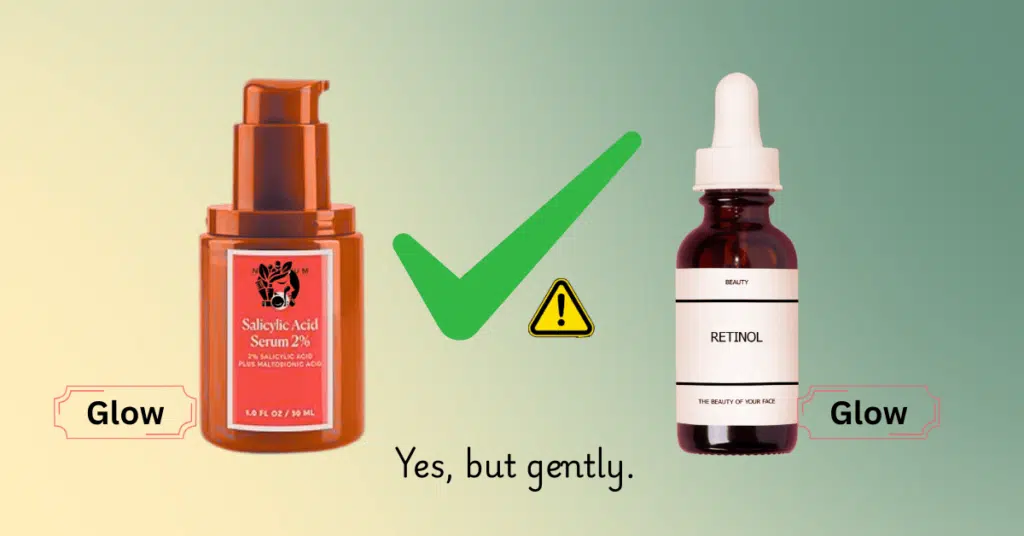
Yes—most people can use salicylic acid and retinol in the same overall routine, as long as you don’t start both at full strength, every night, from day one.
The safest approach: use salicylic acid in the morning or in a rinse-off cleanser, and apply retinol at night. If you have sensitive skin, alternate nights rather than using both on the same day.
Think of them like this:
- Salicylic acid (BHA) → clears oil + debris inside pores, helps blackheads/whiteheads, smooths congested texture.
- Retinol → supports faster cell turnover for smoother texture, fewer marks, and long-term “refined skin” results.
The safest beginner-friendly baseline usually looks like:
- BHA in a cleanser (rinse-off) or a leave-on BHA 2–3×/week
- Retinol at night (start 2–3×/week)
- Moisturizer every time (yes, even oily skin)
- Daily SPF—non-negotiable for results and irritation control
If you’re new to both, don’t “stack strong versions” on the same night. Start gentle, then build. This isn’t a sprint—it’s a results schedule.
Who Should Be Extra Careful (or Wait)
Press pause on combining (for now) if you have very sensitive/reactive skin, active rosacea flares, a compromised barrier (burning/tightness/flaking), or you’re using strong prescription treatments. In those cases, it’s smarter to stabilize first, then introduce one active at a time.
Why This Combo Scares People (and When That’s Actually Valid)
“Will I Burn My Face Off?” – Fear of Over-Exfoliation
Most people aren’t scared of the ingredients themselves.
They’re scared of waking up to:
- A red, shiny, tight face
- Peeling around the mouth and nose
- Breakouts that look worse than before
That fear is not random. Salicylic acid and retinol both speed things up:
- Salicylic acid (BHA): dissolves oil and dead cells inside the pore and on the surface
- Retinol: tells your skin cells to turn over faster
Used well, that’s a glow recipe.
Used recklessly, it’s “why does my face hurt when I smile?”
The biggest over-exfoliation triggers are usually:
- High-strength BHA toner or peel plus strong retinol on the same night
- Using both every single day from week one
- Layering other acids (AHA, PHA) in the same routine “for extra glow”
So the fear comes from a real place—but the solution isn’t “never mix them”.
It’s “don’t throw the whole chemistry set at your face on the same night.”
Purging vs Real Irritation (So You Don’t Gaslight Your Skin)
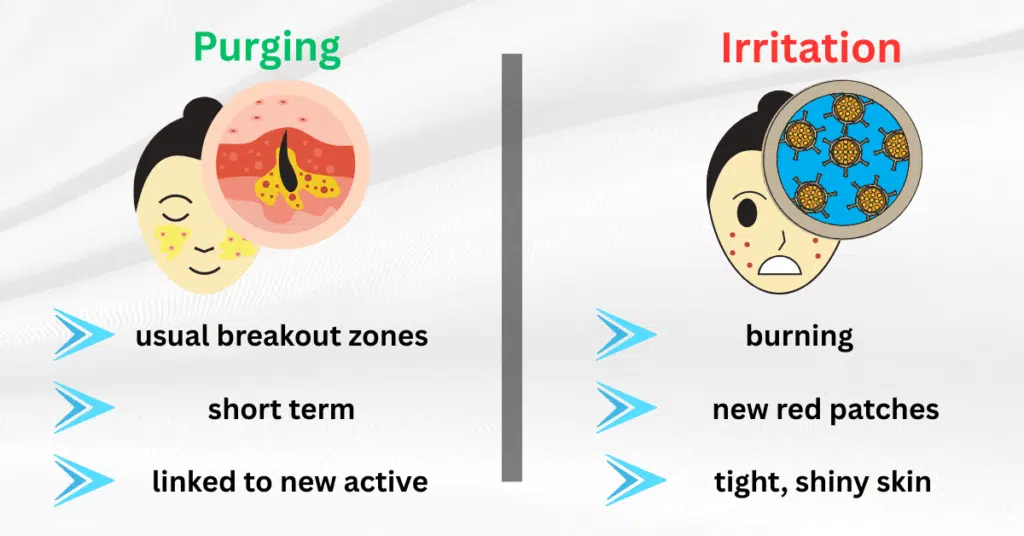
Another reason this combo feels scary: everyone throws the word “purging” around like a magic excuse.
Here’s the simple version:
- Purging
- Happens where you already tend to break out (chin, jaw, T-zone)
- Starts soon after adding a cell-turnover ingredient (like retinol or BHA)
- Looks like your usual acne—just temporarily faster/more
- Usually settles within 4–8 weeks
- Irritation
- Shows up as burning, stinging, raw patches, orange-peel texture
- Often hits areas you don’t normally break out (cheeks, neck, sides of face)
- Skin feels hot, tight, maybe shiny and extra wrinkly when you move
- Gets worse the more you keep pushing
If you add salicylic acid and retinol close together and your skin:
- Stings badly for more than a minute
- Peels in weird places
- Feels tight even after moisturizer
…that’s not “cute purging”, that’s “hey, I’m overwhelmed.”
With this combo, you should always lean on the side of less and then build up, not the other way round.
Why Online Advice Feels So Confusing
You’ve probably noticed:
- One creator says: “Never ever use acids and retinol together.”
- Another casually stacks BHA toner, retinol, and a peel in one reel.
What’s going on?
- Brand blogs often write from a liability mindset: they’d rather say “don’t mix” than deal with angry, over-exfoliated customers.
- Influencers often have:
- Thick, resilient skin
- Years of retinoid use behind them
- Or… they only show the good days and not the “my barrier is destroyed” days.
You’re not any of those people.
You’re one actual human, with one actual face, trying to use the products you already own without destroying your barrier or wasting your money.
That’s why in this guide, we’ll keep asking two questions:
- What does the ingredient do?
- What does your current skin barrier realistically tolerate?
If the answer to #2 is “not much right now”, you’ll still get a plan—but it will start with repair, not combination.
Quick Refresher – What Salicylic Acid and Retinol Do
We don’t need a 2,000-word chemistry lesson here—you already have full ingredient guides on your site. This is the 60-second refresher so the rest of the routine advice makes sense.
Salicylic Acid in One Minute
Think of salicylic acid as your pore-cleaning specialist.
- It’s an oil-soluble BHA, which means it can wiggle through sebum and get into clogged pores.
- It helps:
- Blackheads and whiteheads
- Those tiny, bumpy “congested” areas on forehead or chin
- Some types of inflammatory acne
- You’ll usually see it in:
- Gel or foam cleansers
- Toners and essences
- Spot treatments or serums
The catch? Used too often—or stacked with too many other exfoliants—it can make skin:
- Dehydrated
- Tight and shiny
- More prone to stinging with everything else
If you want the deep dive (strengths, pH, who should avoid it), that lives in my full benefits of salicylic acid guide. Here, we’re focusing on how it behaves next to retinol.
Retinol in One Minute
Retinol is the “slow and steady long-game” ingredient.
- It’s a vitamin A derivative that speeds up how quickly skin cells renew.
- With consistent use, it can:
- Soften fine lines and texture
- Help fade post-acne marks and uneven tone
- Make pores look smoother over time
- You’ll see it in:
- Serums
- Creams
- Sometimes eye formulas (or you’ll use bakuchiol instead on that area)
The catch here?
- It also makes skin more vulnerable if you go too hard too fast—especially when you stack it with strong acids.
- It demands:
- Moisturizer
- SPF
- Patience (think months, not days)
If you need help choosing a formula, start with my best retinol serums under $30 guide so you’re pairing BHA with a gentler, budget-friendly retinol.
When It’s Smart to Use Salicylic Acid and Retinol in the Same Routine
There are moments when this combo makes a lot of sense. If your skin is tough enough and your routine is thoughtful, they can be a really good team instead of a horror story.
Oily, Acne-Prone Skin with Clogged Pores and Marks
If your skin lives in the “always shiny, always breaking out somewhere” zone, you’re basically the target audience for this pairing.
You know the pattern:
- New breakouts on your chin and jaw
- Blackheads that never truly leave your nose
- Old brown or red marks that hang around for months
Here’s where each ingredient shines:
- Salicylic acid goes into the pore, clears out the gunk, and helps stop new clogs from forming.
- Retinol focuses more on the aftermath—texture, marks, early fine lines, that slightly rough look makeup keeps catching on.
Used in a smart schedule (not every night from day one), this combo can:
- Keep pores clearer
- Help fade post-acne marks faster
- Smooth out the “bumpy” look that never fully goes away with just spot treatments
If you’ve already tried either ingredient alone and liked the results but felt they weren’t quite enough, this is when combining them can level things up.
When You Want Anti-Aging Without Sacrificing Clarity
A lot of people hit their late 20s/30s and realize:
“Wow, I still have breakouts and now I’m getting fine lines. Cool.”
Classic “anti-aging” routines are usually built for dry, mature skin—creamy cleansers, rich moisturizers, pure retinol, zero pore talk. If you’re still oily, those routines can make you feel like a glazed doughnut in all the wrong ways.
Salicylic acid + retinol lets you thread that needle:
- Salicylic keeps pores from stretching and clogging under heavier creams
- Retinol works on texture, fine lines, and uneven tone over time
You’re treating acne and aging together instead of bouncing between two completely different routines.
This is also where your Best Retinol Serums Under $30 guide will be gold—because starting with a gentler, budget retinol makes combining with BHA less scary.
When Your Skin Has Already Proved It Can Handle Each One Alone
This is the big rule nobody likes to hear:
If you haven’t used salicylic acid and retinol separately yet, you shouldn’t be combining them.
The combo becomes smart only when:
- You’ve used a salicylic acid product (cleanser, toner, or serum)
- 2–3× a week for a few weeks
- No burning, no crazy peeling
- You’ve used a gentle retinol
- 1–3 nights a week for at least a few weeks
- Mild dryness is okay, full-on lizard shedding is not
If both of those boxes are ticked and your skin is pretty calm, then it makes sense to start weaving them into the same week—carefully.
If not, the smartest thing you can do for your face (and your future self) is to slow down and let each one audition on its own first.
When You Should Not Combine Them (Yet)
There are also situations where your skin is basically waving a little white flag saying, “Please, no more experiments.”
If you’re in any of these camps, you can still use salicylic acid or retinol—but they need to take turns, not share the stage right away.
Very Sensitive, Barrier-Damaged, or Rosacea-Prone Skin
If your skin:
- Turns pink from hot water
- Stings when you put on basic moisturizer
- Has visible flushing or diagnosed rosacea
…then your barrier is already doing a lot of work just existing.
Adding a pore-clearing acid and a cell-speeding retinoid together is like signing your skin up for a boot camp it never agreed to.
In this case, a safer plan is:
- Pick one main active to focus on first
- Either a very gentle BHA 1–2× a week
- Or a low-strength retinol a couple of nights a week
- Keep the rest of your routine boring:
- Fragrance-free cleanser
- Barrier-supporting moisturizer
- SPF 30–50 every morning
Once your skin has been calm for a few weeks or months, you can reassess whether layering—or just alternating—makes sense. And if retinol always feels too harsh, that’s when your Bakuchiol vs Retinol guide becomes the better next step.
You’re Already on Strong Prescriptions or Many Other Actives
If you’re using:
- Oral isotretinoin (Accutane)
- Prescription-strength tretinoin / adapalene most nights
- Regular in-office peels or microneedling
- A full routine of AHA toners, peel pads, and brightening serums
…then your skin is not a blank canvas. It’s already in an active-heavy program.
Adding daily salicylic acid and over-the-counter retinol on top of that can:
- Destroy your barrier
- Make your skin too raw for procedures
- Actually slow down your progress because you keep having to stop everything to heal
In this situation, it’s better to:
- Have a conversation with your derm about which exfoliant or retinoid should lead, instead of self-prescribing every active under the sun.
- Often, that means:
- Stick to the prescription retinoid
- Use only a very mild BHA cleanser if at all
- Or avoid extra acids completely while you’re on a prescription plan
Your Skin Is Already Throwing a Tantrum
You don’t need a spreadsheet to know when your barrier is upset. You can feel it.
Red flags:
- Burning that lasts more than a minute after applying products
- Sharp stinging with water or gentle cleanser
- Shiny, stretched-looking skin that feels too tight
- Sudden eczema-like patches or weird rashy bumps
If that’s your current reality and you’re still thinking, “Maybe I should try salicylic + retinol together,” your skin is quietly begging you for a nap, not a new project.
What to do instead:
- Strip back to barrier repair mode for a few weeks:
- Gentle, low-foam cleanser
- Bland moisturizer (ceramides, glycerin, squalane)
- SPF every single morning
- Pause all strong actives: BHA, AHA, retinol, vitamin C, peels
- Reintroduce one active later, at low frequency, when your face has stopped complaining
You can always come back to this combo once your skin is calm and boring again. Boring skin is easier to improve; angry skin just wants to survive.
How to Combine Salicylic Acid and Retinol Safely
Think of this section as a menu. You don’t have to do everything. You just pick the option that feels closest to your skin and your current routine.
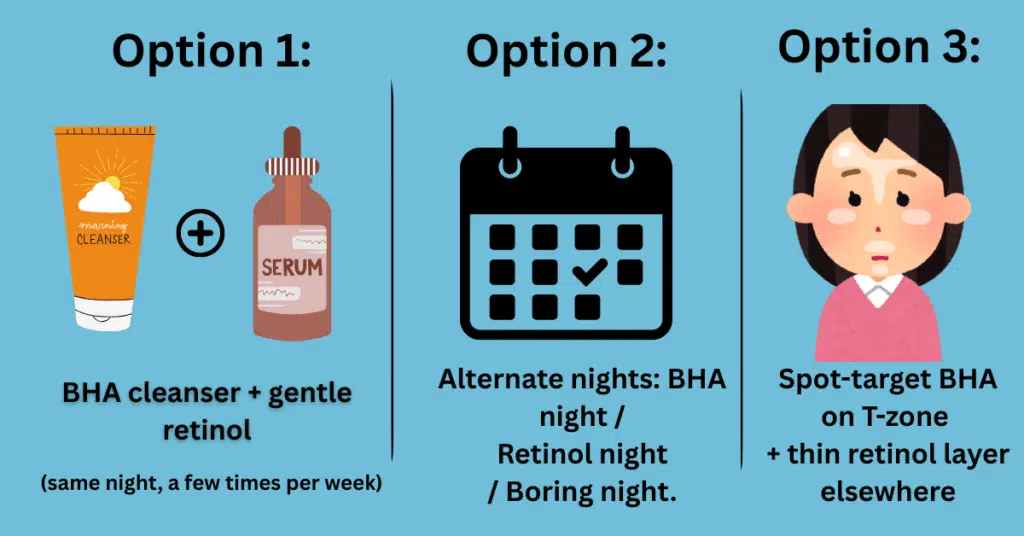
Option 1 – Salicylic Acid Cleanser + Gentle Retinol Serum
This is the softest way to use both, and honestly the best starting point for most people.
Why it’s gentler:
- Salicylic acid in a cleanser is rinse-off, so it doesn’t sit on your skin for hours.
- Retinol stays on, but you choose a low–medium strength formula and cushion it with moisturizer.
How a typical night looks:
- PM – Cleanse with salicylic acid cleanser
- Massage in for 20–30 seconds, don’t scrub.
- Rinse with lukewarm water (no hot showers on face).
- Pat dry and wait a minute
- Your skin shouldn’t feel tight or burning.
- If it does, you might need a milder cleanser or less frequent use.
- Apply a gentle retinol serum or cream
- Pea-sized amount for the whole face.
- Avoid the corners of nose, mouth and eyes at first.
- Follow with moisturizer
- Think creamy, comforting, boring. Ceramides, glycerin, squalane… nothing “tingly”.
- SPF the next morning
- Non-negotiable. Acids + retinol without sunscreen is like cleaning your room then opening all the windows in a dust storm.
This setup gives you pore help at the sink, and texture/anti-aging help on the pillow, without stacking leave-on acids and retinol directly on top of each other right away.
Option 2 – Alternate Nights (BHA Night vs Retinol Night)
If your skin is a bit touchy—or you’re using a stronger BHA or retinol—this is usually the sweet spot.
Think of it as giving your skin different jobs on different nights, instead of making it do everything at once.
Night A – Salicylic Acid Night
- Gentle cleanser (can be BHA cleanser or plain)
- Leave-on salicylic product (toner, serum, or spot treatment)
- Moisturizer
Night B – Retinol Night
- Gentle, non-acid cleanser
- Retinol serum or cream
- Moisturizer
Night C – “Boring” Night (optional but powerful)
- Gentle cleanser
- Hydrating or barrier-support serum (no strong actives)
- Rich moisturizer
Rotate: A → B → C → B or A → C → B → C, depending on what your skin likes.
This approach:
- Lets you enjoy the benefits of both
- Builds in recovery time
- Makes it much easier to spot what’s causing irritation if something goes wrong
You can live on an alternate-night routine for months. There is no prize for “most actives stacked in one evening.”
If you’re also using brightening actives, don’t stack everything at once—especially if you’re new to retinoids. This guide on using retinol and vitamin C together shows a safer schedule so you don’t overload your skin.
Option 3 – Spot-Targeting Only
Maybe your whole face doesn’t need the full force of BHA + retinol. Maybe it’s just your nose, chin and jaw plotting against you.
In that case, targeted use can be smarter than full-face everything.
How that can look:
- Use salicylic acid only on problem zones
- T-zone, sides of nose, chin, jawline
- Either as a toner/serum dabbed on or a short-contact mask
- Use retinol more widely
- Very thin layer over the whole face (avoiding those angry zones if needed)
- Or only on cheeks and forehead if your lower face is reactive
- Always finish with moisturizer
- Even oily skin loves a light, non-comedogenic cream to stop dehydration
This way, blackhead-prone areas get more of the pore help, and the rest of your face still gets a retinol glow without every square inch being attacked by actives.
Patch-Test and “Ease-In” Plan for Cautious Skin
If you’re the anxious type (honestly, that’s a healthy instinct here), use a slow, structured ramp-up instead of guessing.
Week 1–2
- Use salicylic acid 1–2× per week only (cleanser or mild toner).
- No retinol yet if you’re completely new to it—or keep retinol at 1–2 nights per week if you’ve already been using it comfortably.
Week 3–4
- Keep salicylic at 1–2× per week.
- Use retinol 2–3 nights per week, never on the same night as your BHA.
- Watch closely for burning, shiny tightness or new sensitivity.
Week 5+
If your skin is calm:
- You can:
- Add one more BHA night OR
- Add one more retinol night
- Don’t increase both at the same time.
Any time your face starts to feel hot, raw, or constantly itchy:
- Drop back down to the previous level
- Add extra “boring nights” with just cleanser + moisturizer
- Consider whether you need milder formulas (like lower-strength BHA or a creamier, buffered retinol)
Your goal isn’t to “graduate” to daily BHA + retinol as fast as possible. Your goal is a routine your skin can live with for months and years—because that’s how you actually see results.
Routine Examples for Different Skin Types
These aren’t “perfect” routines. They’re starting points you can tweak based on the products you already own.
Oily, Acne-Prone Skin with Clogged Pores and Marks
You want: fewer breakouts, less congestion, and those dark marks to fade without frying your face.
Morning
- Gentle gel cleanser (no acids needed here)
- Optional: light hydrating serum (hyaluronic, glycerin)
- Oil-free moisturizer or gel cream
- SPF 30–50 (matte or gel finish)
Night – using Option 1 (BHA cleanser + gentle retinol)
- Salicylic acid cleanser
- Massage in gently, 20–30 seconds max
- Pat dry
- Gentle retinol serum or cream (2–3 nights per week to start)
- Lightweight, non-comedogenic moisturizer
On non-retinol nights, you can:
- Use the same salicylic cleanser
- Skip retinol
- Moisturizer only
Once your skin has stayed calm for a few weeks, you can:
- Keep the BHA cleanser
- Slowly increase retinol nights, or
- Switch to an alternate-night pattern (BHA Night vs Retinol Night)
For post-acne marks, consider niacinamide on mornings or recovery nights. Here’s my niacinamide for dark spots guide, plus a simple niacinamide usage guide so you don’t overdo it.
Combination Skin (Blackheads + Early Fine Lines)
Your T-zone gets shiny and clogged, but your cheeks are… tired. You want smooth makeup days and a bit of long-term anti-aging.
Morning
- Gentle gel or milk cleanser
- Hydrating serum (optional)
- Lightweight moisturizer
- SPF 30–50
Night – using Option 2 (alternate nights)
Night A – BHA Focus (T-zone only)
- Gentle cleanser
- Salicylic acid toner or serum only on nose, chin and forehead
- Moisturizer over the whole face
Night B – Retinol Focus
- Gentle cleanser (no acids)
- Retinol serum or cream over cheeks, forehead, jawline
- Moisturizer
Night C – Barrier Night (as needed)
- Gentle cleanser
- Hydrating or barrier serum
- Richer cream
Rotate based on how your skin feels. If you’re peeling around the mouth or nose, add more “Night C” and pull back on BHA/retinol nights for a bit.
Sensitive or Retinol-Newbie Skin
You’re curious about results, but your skin gets moody fast. This is where we go slow on purpose.
Phase 1 – 2 Weeks (No Combining Yet)
Morning
- Very gentle, low-foam cleanser (or just a rinse if your derm suggested it)
- Hydrating serum (optional, no acids)
- Moisturizer
- SPF 30–50, fragrance-free
Night
- Gentle cleanser
- Either:
- Tiny pea of retinol 1–2 nights per week, or
- Mild salicylic acid cleanser 1–2 nights per week
- Moisturizer
Not both, not yet. Just let your skin get to know one.
Phase 2 – Weeks 3–4 (Introduce the Second Player)
- Keep your chosen “main” active at the same frequency
- Add the second one on a separate night
- Example:
- Monday: BHA cleanser + moisturizer
- Wednesday: Retinol + moisturizer
- Friday: Boring barrier night
- Example:
Phase 3 – After a Month of Calm Skin
- You can add one more active night (either BHA or retinol),
- But still avoid stacking a strong BHA toner + strong retinol in the same routine.
If at any point your face feels hot, raw, or flaky, you step back a phase. That’s not “failure”; that’s listening.
Best Types of Products to Pair (So They Don’t Fight Each Other)
We’ve talked about routines. Now let’s talk textures and formats, because that’s where a lot of people accidentally torture their skin.
Salicylic Acid Formats That Play Nicely with Retinol
Not all BHA products hit the same.
Safest bets to pair with retinol:
- Salicylic acid cleansers
- Short contact time
- Great for oily or acne-prone skin as a “maintenance” step
- Low-strength BHA toners (1–2% used 1–3× week)
- Only if you’re already comfortable with acids
- Better on alternate nights rather than every night with retinol
Things to be cautious with:
- Strong BHA peel pads on the same night as retinol
- Layering multiple BHA products (cleanser + toner + mask) and then adding retinol on top “because I want fast results”
If your skin is new to both, start with a BHA cleanser. You can always “graduate” to a toner later if needed.
Retinol Textures That Work Better with BHA
If you’re using salicylic acid, you generally want your retinol to be the kind and gentle older sibling, not the strict drill sergeant.
Look for:
- Cream-based retinols
- Often called “hydrating” or “buffered”
- Great if you’re acne-prone and easily dehydrated
- Encapsulated or “gentle” retinol
- Slower release, less irritation risk
- Lower strengths to start
- You can always go stronger later if your skin truly wants more
Be cautious with:
- Very high-strength retinol or retinal + frequent BHA use
- Retinol products that already include AHA/BHA inside the formula if you’re also using separate acids
The vibe you want is: one clear exfoliant, one clear retinoid, plenty of moisturizer—not a mystery cocktail in every bottle.
Common Mistakes When Using Salicylic Acid with Retinol
This is where most barrier meltdowns happen. If you avoid these, you’re already ahead of 80% of people on Reddit.
1. Using High-Strength Everything… All at Once
- 2% BHA toner
- AHA serum
- 1% retinol
- “Just a little” peeling solution on Sundays
Your skin doesn’t care that each product has great reviews. It only knows the total.
If you’ve got multiple “strong” labels in your routine, pick one main hero and let the rest step back.
2. Skipping Moisturizer Because You’re Oily
Oily, acne-prone people get tricked into thinking:
“If I hydrate too much, I’ll break out more, so I’ll just use my actives and that’s it.”
Then they wonder why:
- Their skin feels tight underneath the oil
- Every active stings
- Makeup clings weirdly to dry patches
BHA + retinol without moisturizer is like sanding wood and never sealing it. You’re leaving the surface exposed and angry.
You still want:
- Lightweight, non-comedogenic gel or cream
- Barrier-loving ingredients (glycerin, hyaluronic, ceramides, squalane)
Hydrated skin handles actives better. Period.
3. Starting Both at the Same Time and Every Night
If you add salicylic acid and retinol to your routine on the same day, use them every night, and then wake up irritated, that’s… exactly what we’d expect.
A safer pattern is always:
- Introduce one active
- Let your skin adapt
- Introduce the second one later
- Then maybe experiment with combining or alternating more often
Slow is not boring. Slow is what future-you thanks you for.
4. Ignoring Sunscreen
Both BHA and retinol can make skin more sensitive to the sun, even if you only use them at night.
No SPF means:
- Dark marks come back
- New sun damage piles on
- All that hard work with actives gets undone
If you’re going to bother with this combo, make SPF the non-negotiable step. Otherwise you’re just doing skin chores for fun.
If post-acne marks are your main concern, use a calm brightening plan (not more acids). My best vitamin C serums for brightening guide shares gentler options that work well on non-retinol mornings.
FAQs: Using Salicylic Acid with Retinol
Q1. Can I use a salicylic acid cleanser and a retinol serum on the same night?
Yes—this is one of the gentler ways to combine them. Use the salicylic cleanser, rinse well, pat dry, then apply a small amount of gentle retinol and follow with moisturizer. Start just a few nights per week and watch for burning or unusual dryness.
Q2. Is it better to use salicylic acid in the morning and retinol at night?
For many people, yes. Salicylic acid in a cleanser or light toner can work well in the morning for oil control, while retinol is traditionally used at night to support repair. Just don’t forget sunscreen in the morning, because both actives can make skin more sun-sensitive over time.
Q3. Can teens use salicylic acid and retinol together?
Teens usually do better focusing on one main active at a time—often salicylic acid for acne and congestion. Retinol can be useful in specific cases, but it’s something to discuss with a dermatologist, especially if there’s already a prescription acne routine in place. More actives isn’t automatically better.
Q4. How often can I use salicylic acid with retinol?
There’s no one magic number. A common starting point is:
- Salicylic acid 1–3× per week
- Retinol 2–3× per week
on separate nights, plus at least one plain “moisturizer only” night. If your skin stays calm for a month, you can slowly increase frequency—but always one product at a time, not both together.
Q5. How do I know if I’ve overdone it with this combo?
Signs you’ve pushed too far include burning that lasts, stinging with water, shiny tight skin, more redness than usual, or weird rash-like bumps. That’s your cue to stop both actives, go into repair mode with gentle cleanser, moisturizer and SPF only, and reintroduce them later at a lower dose and frequency.
Q6. Is there anyone who should avoid combining them completely?
Yes. If you have active eczema flare-ups, severe rosacea, a history of strong reactions to exfoliants, or you’re on prescription isotretinoin or strong tretinoin, you should not experiment with this combo on your own. In those cases, a derm-supervised plan or gentler alternatives (like azelaic acid or bakuchiol) are usually safer.
Comparison Table: Salicylic Acid vs Retinol vs Both
| Salicylic Acid (BHA) | Retinol | Salicylic Acid + Retinol Together |
|---|---|---|
| Main benefits: Unclogs pores by dissolving oil and dead skin inside the pore, helps blackheads, whiteheads and congestion, smooths rough texture. | Main benefits: Speeds up cell turnover, softens fine lines and texture, helps fade post-acne marks and uneven tone, supports long-term skin smoothness. | Main benefits: Targets active breakouts and clogged pores while also working on texture, post-acne marks and early signs of aging. |
| Best for: Oily and acne-prone skin, blackheads, bumpy forehead or chin, clogged T-zone. | Best for: Early fine lines, rough or crepey texture, long-lasting dark marks and overall dullness. | Best for: Oily or combination skin that still breaks out but also wants anti-aging and smoother texture. |
| Irritation risk: Can cause dryness, tightness and sensitivity if used too often or with other strong exfoliants. | Irritation risk: Can cause peeling, dryness and temporary flare-ups, especially at higher strengths or if started too quickly. | Irritation risk: Higher if you overuse both or stack strong versions in the same routine; needs careful frequency, buffering and lots of moisturizer. |
| Ideal use: A few times per week as a cleanser, toner or serum, depending on tolerance. | Ideal use: 2–3 nights per week to start, then gradually more often if skin stays calm, always with moisturizer and SPF. | Ideal use: Salicylic acid in a cleanser or on alternate nights, paired with a gentle retinol 2–3 nights per week, plus at least one “boring” barrier-repair night. |
| Safest formats: Short-contact cleansers or low-strength toners used a few times per week. | Safest formats: Cream-based or encapsulated, low-to-medium strength retinol. | Safest combo: BHA cleanser + gentle retinol serum or cream, or alternating BHA nights and retinol nights instead of stacking strong leave-ons together. |
Leave a Reply