

You know that moment when you’re standing over the sink, holding two bottles and thinking,
“If I put these on together, will my face explode… or glow?”
One says niacinamide. The other says vitamin C.
TikTok says they cancel each other out. A derm on Instagram says they’re best friends.
Your skin is somewhere in the middle, quietly begging you not to start a war on your face.
This guide is for that exact moment.
Updated for 2026: refreshed the “can they be used together?” science, added a no-pilling layering checklist, and updated routine examples (including sensitive-skin options + AM/PM split templates).
We’re not going to re-teach Skincare School 101 or throw pH charts at you. You already know niacinamide is good for your barrier and pores, and vitamin C is good for glow and dark spots. The real question in your head is much simpler:
“Can I actually use them together without messing up my skin… or wasting my money?”
Let’s answer that clearly first, then we’ll get into routines and product pair ideas.
TL;DR: Yes — niacinamide and vitamin C can be used together. Most people tolerate them well, and they often work better as a duo for brightening, dark spots, and barrier support.
For most skin types, apply vitamin C first in the morning, let it absorb for a few minutes, then layer niacinamide over it.
- Quick Answer: Can You Use Niacinamide with Vitamin C?
- Why People Think Niacinamide and Vitamin C Don’t Mix
- How Niacinamide and Vitamin C Help the Same Skin Issues
- When It’s Smart to Use Niacinamide and Vitamin C Together
- When You Might Want to Separate Them
- How to Layer Niacinamide and Vitamin C (Order, AM vs PM)
- Routine Examples for Different Skin Types
- Best Types of Products to Pair (So They Actually Layer Well)
- Product Pair Ideas: Niacinamide + Vitamin C Duos
- Comparison Table: Niacinamide vs Vitamin C vs Both
- FAQs: Using Niacinamide with Vitamin C
- Final Thoughts & Next Steps
Quick Answer: Can You Use Niacinamide with Vitamin C?
The Short, Honest Answer
Yes, you can use niacinamide and vitamin C together.
Modern formulas are designed to play nicely in real-world conditions (normal bathroom temperatures—not boiling lab experiments from decades ago). For most people:
- They don’t cancel each other out
- They don’t magically turn toxic
- They can actually work better as a team—vitamin C brings the brightening and antioxidant protection, niacinamide brings the calming, barrier support and extra help with uneven tone
If your skin is fairly normal or just a bit combination/oily, you can usually:
- Use a vitamin C serum in the morning
- Layer niacinamide over it or use niacinamide at night
- And be totally fine, as long as you’re also wearing SPF (and reapplying it correctly—see how to reapply sunscreen over makeup) If you wear base makeup, use an SPF that won’t fight your foundation—this guide has the best “no-pill” picks: Best Sunscreens Under Makeup (2026).
No fireworks. No secret chemical disaster. Just a solid brightening routine.
Who Should Be a Bit More Careful With This Combo?
There are some skin types that need a gentler approach. If you see yourself in any of these, you can still use both—just with a smarter setup (lower strength, fewer layers, and a slower ramp-up):
- Very sensitive or reactive skin
You flush easily, sting with lots of products, or have rosacea. Strong, acidic vitamin C plus a bunch of other actives in the same routine can be too much. - You’re using a high-strength, low-pH vitamin C
Those 15–20% ascorbic acid serums that tingle a lot can be powerful but prickly, especially if your barrier isn’t happy. - Your routine is already crowded with actives
Retinoids, exfoliating acids, benzoyl peroxide, azelaic acid… and now niacinamide + vitamin C on top. Even if each is “fine,” the total can push your skin over the edge.
If retinol is in your routine too, follow this safe layering map (AM/PM + spacing): Can You Use Retinol and Vitamin C Together?.
2026 shortcut: If you’re sensitive, aim for ~2–5% niacinamide and a gentler vitamin C (or lower strength) at first. If you’re oily/combination and tolerant, you can usually handle higher percentages—just don’t stack every active in one routine.
If that’s you, it doesn’t mean “never mix them.” It usually means:
- Start with one active at a time (introduce vitamin C or niacinamide first, not both at once)
- Consider splitting them into AM and PM instead of layering immediately
- Watch your skin, not the bottle—if you’re burning, peeling, or getting more inflamed, it’s a routine problem, not a moral failing
Why People Think Niacinamide and Vitamin C Don’t Mix
Where the “They Cancel Each Other Out” Myth Came From
The “they cancel each other out” rumor comes from chemistry concerns that don’t match real skincare use.
In older discussions, the worry was that very acidic vitamin C (pure L-ascorbic acid) plus niacinamide could be less comfortable for some skin types under extreme conditions (think: heat + long exposure + lab-style setups). That got simplified online into: “Never mix them.”
2026 reality: modern formulas are tested as complete products, many brands use stabilized vitamin C forms, and plenty of routines (and even single products) include both ingredients without “canceling” anything. What matters more is your barrier, your formula strength, and how many actives you stack.
Old Studies vs Modern Formulas
Fast-forward to now:
- Brands use stabilized vitamin C derivatives and better packaging
- Finished products are tested for stability and irritation as a whole formula, not just one ingredient in a beaker
- Derms routinely recommend routines where niacinamide and vitamin C live together peacefully—sometimes even in the same bottle
So while the original chemistry concern wasn’t made up, it’s not a realistic snapshot of how your actual skincare works at home.
What Actually Happens on Your Skin (Not in a Lab Beaker)
On your face, at normal bathroom temperature, here’s what’s more relevant:
- Vitamin C gives you antioxidant protection, brighter tone and help with dark spots
- Niacinamide helps support your barrier, calm redness and regulate excess pigment
- They sit on your skin for a while, do their jobs, and then you cleanse them off later
No sudden explosion. No instant neutralization. Instead, you get a routine that can:
- Brighten and protect (vitamin C)
- Soothe and strengthen (niacinamide)
…which is exactly what easily irritated, uneven skin usually needs.
How Niacinamide and Vitamin C Help the Same Skin Issues
Dullness, Dark Spots and Uneven Tone
- Vitamin C helps fade dark spots by slowing pigment production and gives that “lit from within” brightness.
- Niacinamide helps reduce excess pigment transfer and smooth out patchy tone over time.
Together, they’re like a brightening duo: one dims the “pigment switch,” the other stops extra pigment from moving to the surface.
Redness, Sensitivity and Barrier Support
- Vitamin C can sometimes be a little spicy on its own—especially in high strengths
- Niacinamide is like the friend who says, “Okay, let’s calm down a bit,” supporting the barrier and soothing background irritation
That’s why a lot of people who couldn’t tolerate vitamin C alone suddenly do better when niacinamide is somewhere else in their routine.
Fine Lines and “Tired” Skin Look
- Vitamin C supports collagen and fights free radical damage from pollution and UV
- Niacinamide helps with texture, enlarged pores and overall smoothness
The result isn’t frozen, wrinkle-less skin—but it does look more awake, more even, and less “why do I look so tired?” in the mirror.
Read More: full niacinamide usage guide
When It’s Smart to Use Niacinamide and Vitamin C Together
There are a few situations where this combo makes a lot of sense—and honestly, most people with dark spots or dullness are already in one of them.
If You’re Targeting Dark Spots and Acne Marks
You’ve got:
- Old breakouts that left brown or purplish shadows
- Random sun spots on cheeks or forehead
- That overall “patchy” tone that concealer can’t fully hide
If your main issue is PIH/post-acne marks, this guide pairs perfectly with this routine: Niacinamide Serum for Dark Spots.
Here’s why using both makes sense:
- Vitamin C works on pigment production and gives overall brightness
- Niacinamide works on pigment transfer and helps the skin let go of old marks more evenly
You’re hitting the same problem from two angles. That’s smart skincare, not “too much.”
If fading dark spots is your main goal, pair this article with your routine from Niacinamide Serum for Dark Spots
If Your Skin Gets Irritated by Strong Vitamin C Alone
You tried a vitamin C serum once, it tingled, maybe made you a bit red, and you shoved it to the back of the drawer.
Sometimes it’s not that vitamin C is “bad” for you—it’s that your barrier is already a bit fragile. Niacinamide can help with that:
- It reinforces your barrier, so the skin is less reactive overall
- It can calm some of the background redness that makes every active feel harsher
Using niacinamide somewhere in your routine—same routine or opposite time of day—can make vitamin C more tolerable over time.
If You Want Glow and Comfort in the Same Routine
There’s “glass skin” and then there’s “glassy but my face hurts.” We’re going for the first.
- Vitamin C brings the instant and long-term glow
- Niacinamide brings the smooth, refined, calm look
If you want your skin to look good with makeup and without, pairing these two is an efficient way to build that calm, even “healthy skin” finish. For mature-skin base picks, start here: Best Foundation for Ladies Over 50.
When You Might Want to Separate Them
Not every face loves a cocktail.
There are times where you absolutely can use both—but it’s smarter to give them their own shift (AM vs PM) instead of piling them on all at once.
Very Sensitive, Reactive or Rosacea-Prone Skin
If your skin:
- Flushes just from hot water
- Stings with a lot of products
- Has visible, ongoing redness or diagnosed rosacea
…then layering multiple actives in the same routine is like turning up every volume knob at once.
In that case:
- Try vitamin C in the morning, niacinamide at night, or
- Start with niacinamide alone for a few weeks to calm things down, then slowly introduce vitamin C
You’re Using a Strong, Low-pH Vitamin C
Those 15–20% ascorbic acid serums in watery formulas? Powerful, but spicy.
If yours:
- Tingles a lot
- Smells a bit metallic or “hot dog water”
- Or specifically says it’s a low-pH treatment
…then consider:
- Keeping that vitamin C on its own layer (cleanse → vitamin C → moisturizer → SPF)
- Letting niacinamide live in the evening routine or in a separate product later in the morning, like a moisturizer instead of a serum
You’re not avoiding the combo; you’re just giving skin room to breathe.
Signs Your Skin Wants a Break
Listen to your face. If you start combining actives and notice:
- Burning that lasts more than a minute
- Sharp stinging every time
- New flakiness, tightness or angry red patches
That’s not “purging”—that’s irritation.
Pull back to:
- A very simple routine (cleanser, niacinamide or bland hydrating serum, moisturizer, SPF)
- Reintroduce vitamin C later, in smaller amounts and less often
Your skin is not a science experiment; it’s tissue. It’s allowed to say “no.”
If your skin feels tight or stingy, add a cushioning hydration step before actives: Best Hyaluronic Acid Serums (guide).
How to Layer Niacinamide and Vitamin C (Order, AM vs PM)
Let’s answer the practical stuff your brain keeps circling back to.
Which Goes First—Niacinamide or Vitamin C?
General rule:
- Go from thinnest to thickest texture
In real life, that often looks like:
- Cleanser
- Watery toner/essence (optional)
- Thinnest serum – usually vitamin C
- Slightly thicker serum – often niacinamide
- Moisturizer
- SPF (in the morning)
If both are similar textures, don’t obsess. Pick an order and stay consistent. Skin cares more about overall gentleness and consistency than about which one touched it first.
2026 No-Pilling Layering Checklist (30 Seconds, Max)
- Use less than you think: 2–3 drops of serum is plenty.
- Let vitamin C set: wait 30–60 seconds before the next layer.
- Avoid “grippy on grippy”: too many silicone-heavy layers can pill.
- Moisturizer can be a buffer: if you’re sensitive, use vitamin C → moisturizer → niacinamide (or split AM/PM).
- SPF last (AM): apply, then wait 2–3 minutes before makeup.
If your skin feels tight or easily irritated when you start adding actives, slipping a simple hydrating serum between cleansing and your treatments can help. I’ve reviewed several in my best hyaluronic acid serum guide.
Using Them in the Same Routine vs Splitting AM/PM
You’ve got two main strategies:
Option 1 – Same routine (for most normal/combination skins)
- AM: Cleanser → Vitamin C → Niacinamide → Moisturizer → SPF
Bonus (2026 glow girl move): if you wear makeup, switch to a touch-up friendly SPF format. Here are my top picks: best sunscreen stick for face (2026).
- PM: Gentle routine with niacinamide or other actives (like retinoids) according to tolerance
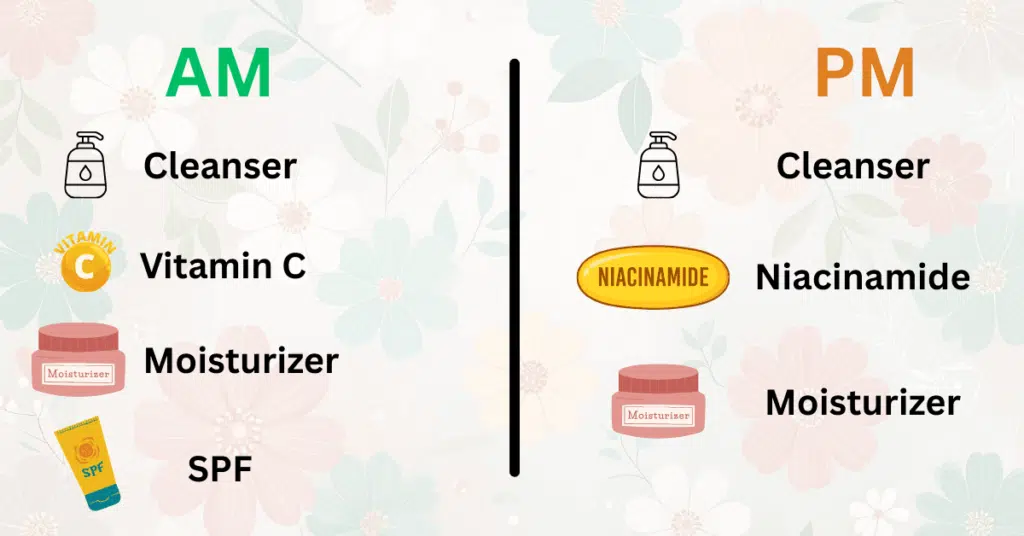
Option 2 – Split routine (for sensitive or active-heavy routines)
- AM: Cleanser → Vitamin C → Moisturizer → SPF
- PM: Cleanser → Niacinamide → Moisturizer
You still get the benefits of both ingredients over 24 hours without forcing your skin to juggle everything at once.
Patch-Test and “Ease-In” Plan for Cautious Skin
If you’re the nervous type (totally valid), try this:
- Week 1–2
- Use vitamin C every other morning
- Use niacinamide every evening
- Week 3–4
- If things are calm, start using vitamin C most mornings, keeping niacinamide in the evening
- Week 5+
- If your skin still feels great, you can test layering niacinamide on top of vitamin C in the morning 2–3 times a week
Any time irritation shows up, step back to the previous level.
Read More: full niacinamide usage guide
Routine Examples for Different Skin Types
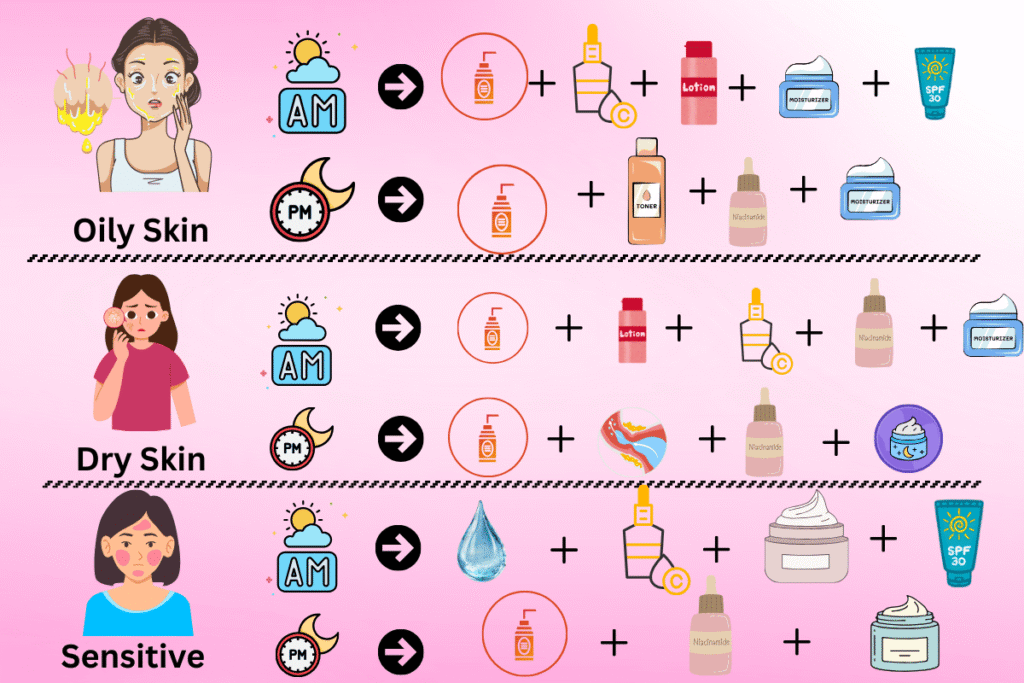
Oily, Acne-Prone Skin with Dark Marks (AM/PM Example)
Morning
- Gel cleanser
- Vitamin C serum (thin, non-greasy)
- Niacinamide serum or lightweight lotion
- Oil-free moisturizer (if you need it)
- SPF 30–50 (matte or gel finish)
Night
- Gentle cleanser
- (2–3 nights/week) BHA or gentle exfoliating toner
- Niacinamide serum (focus on areas with marks and larger pores)
- Light, non-comedogenic moisturizer
This routine keeps things bright, helps fade post-acne marks, and doesn’t smother oily skin.
Dry, Dull or Mature Skin (AM/PM Example)
Morning
- Creamy or milk cleanser
- Hydrating toner or essence
- Vitamin C serum
- Niacinamide serum or hydrating niacinamide toner
- Rich but non-greasy moisturizer
- SPF 30–50 (lotion or cream texture)
Night
- Creamy cleanser
- (Optional) Gentle lactic acid 1–2 nights/week
- Niacinamide serum
- Barrier-loving night cream (ceramides, squalane, etc.)
Here, vitamin C is doing the “glow + collagen” job, while niacinamide supports barrier and tone so dryness doesn’t get worse.
Sensitive Skin “Slow and Gentle” Routine (AM/PM Example)
Morning
- Very gentle, low-foam cleanser (or just water if your derm suggested it)
- Mild, low-strength vitamin C or a vitamin C derivative serum, 2–3× per week
- Niacinamide moisturizer (instead of a separate strong serum)
- SPF 30–50, fragrance-free
Night
- Gentle cleanser
- Niacinamide serum or moisturizer (no acids, no extras at first)
- Simple, fragrance-free cream
If your skin stays calm for a few weeks, you can slowly increase vitamin C days or switch to a slightly stronger formula—but niacinamide stays in the routine as your “bodyguard.”
Best Types of Products to Pair (So They Actually Layer Well)
Before we talk exact duos, it helps to understand what kind of formulas usually behave well together.
Vitamin C Serums That Layer Nicely
From the picks you’re using on Amazon:
- TruSkin Vitamin C Super Serum – a richer, all-in-one serum with vitamin C, niacinamide, retinol, hyaluronic acid and squalane in a creamy texture. Great for all skin types that tolerate actives well.
- EQQUALBERRY Vitamin Illuminating Serum – brightening formula with acerola (vitamin C), arbutin, ceramides, niacinamide and vitamin E. Silky, quick-absorbing, designed to hydrate and support the barrier while brightening.
- Good Molecules Vitamin C Serum with Oryzanol – a budget gel-cream vitamin C serum that smooths on softly, brightens and helps with acne marks and fine lines, though some people find it a little drying or sticky.
These give you a rich all-rounder, a barrier-friendly brightener, and a budget workhorse.
If you’re building a full glow routine beyond vitamin C, start here: best serum for glowing skin.
More Options: best vitamin C serums for brightening
Niacinamide Formulas That Play Well With Them
Good pairings from your niacinamide lineup:
- ANUA Niacinamide 10 + TXA 4 Serum – watery, K-beauty style, great over or separate from vitamin C for dark spots and PIH
- First Aid Beauty Dark Spot Serum – niacinamide-based with a sensitive-skin-friendly profile and a long “free from” list
- Good Molecules Discoloration Correcting Serum / Minimalist Niacinamide Serum – simple, budget niacinamide options that layer easily and focus on discoloration and texture
We’ll avoid stacking too much in one routine: that’s why some duos are AM/PM splits rather than double-serum sandwiches.
If you’re building a polished, soft-focus base on top of this routine, you’ll like: Best Luxury Foundation (by skin type).
Textures That Pill vs Textures That Play Nice
To avoid that annoying “eraser crumbs” pilling:
- Don’t stack too many silicone-heavy products in one routine
- Let each layer fully dry before adding the next (especially vitamin C)
- Keep at least one of the two (often niacinamide) in a simple, non-grippy texture
Also: primer can be the silent pilling trigger. If you’re mature or dry, choose a smoother, non-grippy base: Best Organic Face Primers for Mature Skin.
If things still pill, simplify: vitamin C + niacinamide + moisturizer is plenty.
Still getting little “eraser crumbs”? Here’s the exact why + fix: Sunscreen Pilling Under Makeup (2026): Why It Happens + The No-Pill Fix.
Product Pair Ideas: Niacinamide + Vitamin C Duos
Everyday Duo for Dark Spots and Glow
(TruSkin Vitamin C Super Serum + ANUA Niacinamide 10 + TXA 4)
This combo is for you if you want visible brightening, smoother texture and help with dark spots, and your skin can handle an active-rich routine.
AM – Brightening & Protection
- Gentle cleanser
- TruSkin Vitamin C Super Serum
- Creamy texture with vitamin C, niacinamide, hyaluronic acid and retinol in one stepGreat if you want fewer layers but more benefits: brightness, firmness and softer dark spots over time
Shop TruSkin Vitamin C Super Serum on Amazon - Lightweight moisturizer
- SPF 30–50
PM – Targeted Dark Spot Support
- Cleanser
- ANUA Niacinamide 10 + TXA 4 Serum
- Watery, essence-like texture that sinks in fast10% niacinamide + 4% tranexamic acid focus on PIH and uneven tone while your skin rest
Shop ANUA Niacinamide 10 + TXA 4 Serum on Amazon - Barrier-supporting moisturizer
Why this works:
You let TruSkin handle multi-tasking brightness and firmness in the morning, then let ANUA quietly chip away at dark spots and PIH at night. You’re not stacking too many actives at once, but you’re still using both niacinamide and vitamin C daily.
Sensitive-Skin-Friendly Duo
(EQQUALBERRY Vitamin Illuminating Serum + First Aid Beauty Dark Spot Serum)
This pairing is ideal if your skin is easily irritated, but you still want to tackle uneven tone and dark spots.
AM – Gentle Vitamin C + Barrier Love
- Very gentle cleanser
- EQQUALBERRY Vitamin Illuminating Serum (2–4 mornings per week to start)
- Uses acerola-derived vitamin C plus niacinamide, ceramides, hyaluronic acid and vitamin ESilky texture designed to hydrate and support the barrier while brightening
Shop EQQUALBERRY Vitamin Illuminating Serum on Amazon - Simple, fragrance-free moisturizer
- SPF 30–50
PM – Calm, Steady Niacinamide
- Cleanser
- First Aid Beauty Dark Spot Serum
- Niacinamide-based formula created for sensitive skinTargets dark spots and post-acne marks without wrecking your barrier
Shop First Aid Beauty Dark Spot Serum on Amazon - Barrier cream (ceramides, shea, squalane)
Why this works:
EQQUALBERRY gives you a brightening, hydrating push with barrier-friendly ingredients, while First Aid Beauty keeps nights calm, consistent and pigment-focused, so your skin isn’t juggling too many strong acids or retinoids at the same time.
Budget-Friendly Duo for Dark Spots and Acne Marks
(Good Molecules Vitamin C Serum + Good Molecules or Minimalist Niacinamide)
You want dark-spot help without blowing your budget. This pair keeps the steps simple and the price tags gentle.
AM – Affordable Vitamin C Glow
- Cleanser
- Good Molecules Vitamin C Serum with Oryzanol
- Gel-cream texture that feels smooth and softHelps brighten tone and soften the look of fine lines and acne marks
Shop Good Molecules Vitamin C Serum on Amazon - Lightweight but hydrating moisturizer
- SPF 30–50
PM – Budget Niacinamide for Discoloration
Option A – Same Brand Combo
- Good Molecules Discoloration Correcting Serum
- Focused on hyperpigmentation and post-acne marksWorks nicely at night after cleanser and before moisturizer
Shop Good Molecules Discoloration Correcting Serum on Amazon
Option B – Minimalist Approach
- Minimalist Niacinamide Serum
- Straightforward niacinamide formula for oil control + toneIdeal if you want something very simple around your vitamin C
Shop Minimalist Niacinamide Serum on Amazon
Why this works:
You keep costs down by pairing one budget vitamin C with one budget niacinamide, but you’re still addressing discoloration from two directions: brightening in the morning and pigment support at night.
Comparison Table: Niacinamide vs Vitamin C vs Both
| Niacinamide | Vitamin C | Niacinamide + Vitamin C Together |
|---|---|---|
| Main benefits: Calms redness, supports the skin barrier, refines texture and pores, helps even out tone over time. | Main benefits: Brightens, targets dark spots, boosts collagen, protects against free-radical damage from UV and pollution. | Main benefits: Targets dark spots and dullness from two angles while keeping the barrier supported and calm. |
| Best for: Sensitive, oily or combination skin; post-acne marks; reactive or easily irritated skin. | Best for: Dullness, sun damage, early fine lines, dark spots and overall lack of glow. | Best for: Uneven tone, PIH from acne and “tired” looking skin that needs both brightness and resilience. |
| Irritation risk: Generally low; may tingle if the formula is strong or your barrier is already damaged. | Irritation risk: Moderate; higher with strong, low-pH formulas or very sensitive skin. | Irritation risk: Depends on the formulas and your barrier; best used with a gentle routine and good moisturizer. |
| Ideal use: AM or PM, daily, as a “support” serum or moisturizer step. | Ideal use: Mostly AM for antioxidant protection under SPF; PM if your skin prefers it. | Ideal use: Vitamin C first in the AM, niacinamide layered after or used at night for extra support. |
FAQs: Using Niacinamide with Vitamin C
Do niacinamide and vitamin C cancel each other out?
No. That idea came from old lab experiments using raw ingredients at high heat and very low pH—nothing like your actual bathroom routine. Modern, room-temperature skincare formulas with stabilized vitamin C and niacinamide are designed to be used together, and derms routinely recommend them in the same routine.
Is it safe to layer niacinamide and vitamin C on my skin?
For most people with a normal or mildly sensitive barrier, yes. You can safely layer a vitamin C serum under a niacinamide serum or moisturizer, especially in the morning under SPF. If your skin is very reactive, it’s better to start slowly and split them into AM and PM instead of stacking everything at once.
Which should I apply first, niacinamide or vitamin C?
In general, apply the thinnest texture first. Most vitamin C serums are watery or very light, so they usually go on before a slightly thicker niacinamide serum or lotion. If both feel similar, don’t stress—pick an order, stay consistent, and focus more on gentle formulas and daily SPF.
Can I use niacinamide and vitamin C if I have sensitive or rosacea-prone skin?
Often you can, but you need a more gentle strategy. Start with niacinamide alone for a few weeks to calm and support your barrier. Then introduce a mild, low-irritation vitamin C derivative a few mornings per week. If your skin stays calm, you can slowly increase vitamin C days. If stinging or burning shows up, pull back and simplify again.
Should I use niacinamide and vitamin C in the same routine or separate them?
It depends on your skin:
- Normal / combo / oily, not very sensitive: using them in the same AM routine (vitamin C → niacinamide → moisturizer → SPF) is usually fine
- Sensitive or very active-heavy routines: split them—vitamin C in the morning, niacinamide at night—so your skin has fewer actives to process at once
Can I use niacinamide and vitamin C with retinol or exfoliating acids?
Yes, but be careful with “ingredient stacking.” If you’re already using retinoids or exfoliating acids, it’s easy to overwhelm your barrier. A safer approach is:
If you’re starting to add retinol into the mix, read my guide on can you use retinol and vitamin C together for a full breakdown of how to layer those actives safely. And if you’re curious about gentler alternatives, my Bakuchiol vs Retinol comparison explains which one makes more sense for your skin type and tolerance.
Once you’re comfortable with the basics, you can also explore affordable options from my best retinol serums under $30 roundup before you build a more advanced routine.
- AM: vitamin C + niacinamide + SPF
- PM (on some nights): retinoid or exfoliating acid, with niacinamide in a gentle moisturizer to support your barrier
If your skin is flaky, burning or very tight, you’re doing too much—cut back on actives.
How long will it take to see results from using niacinamide and vitamin C together?
Most people notice a softer, more even glow in 4–8 weeks, with post-acne marks and sun spots gradually fading over 8–12 weeks when they use niacinamide and vitamin C consistently with daily SPF. Deeper melasma or long-standing sun damage can take longer and may need help from a dermatologist.
Final Thoughts & Next Steps
Niacinamide and vitamin C aren’t enemies—they’re more like co-workers who get the best results when they’re assigned the right roles.
- Vitamin C: brightness, dark spots, protection
- Niacinamide: calm, barrier support, smoother texture
Your next steps:
- Choose a combo that fits your skin and budget (everyday, sensitive, or budget duo).
- Decide if you’re a “same routine” person (normal/combination) or a “split AM/PM” person (sensitive or very active-heavy routine).
- Stick with it for at least 8–12 weeks, with daily SPF, before judging the results.
If you want a deeper dive into strengths, side effects and how often to use it, my niacinamide usage guide walks you through percentages, what to mix it with and what to avoid.
Leave a Reply